- 1. MORPHOLOGY OF THE SACRED UTTERANCE. — 2. THE UNIVERSE AND THE DROP OF WATER, CRYSTALS, LILIES, EYE, PLATES. — 3. THE STANDARD AND ITS DERIVATIVES.
- 4. THE VESSELS OF ELECTION THREE STYLES. — 5. THE SACRED COLUMNS SEVEN DIATONIC STYLES.
- 6. THE CHAPELS OF THE HOLY NAME OF MARY FOUR STYLES. — CATHEDRAL CHURCHES
THE METROPOLITAN OF THE HOLY NAME OF JESUS.
Under the name Archeometer, we have invented, registered, and published as our seal and mark a diagram of the science of cosmological correspondences founded upon the Utterance and its Equivalents.
We therefore need not describe it here again, but shall apply it as a Protractor to Musical Architecture, whose principle and Laws it contains.
This principle and these Laws also concern all aesthetic Arts and Crafts capable of entering into monumental synthesis—sacred or secular—or of being detached therefrom.
In other words, the architectural Species specified by the Utterance or its musical Equivalents may imprint the unity of its harmony upon all that an Edifice contains of aesthetically combined forms and colors, whatever substance be employed: ornamentation, mosaics, frescoes, stained glass or glazing, hangings, carpets, furnishings, ceramics, statuary, tombs, fabrics, linens, lace, garments, goldsmithing, ironwork, etc., etc.
The religious Edifice is that which demands the greatest conformity to Principle, the most exact observance of Archeometric Laws and all their correspondences. It is therefore through religious architecture that we shall make our demonstration—which shall be all the more valid for applying our method to secular Arts.
To erect a monument according to its principle and laws, we employ several precision instruments, among which:
- 1° The Archeometer as universal Protractor;
2° The Archeometric Standard as Rule of Arithmology, Metrology, and musical Morphology;
3° A Protractor for the degrees of the Archeometer, concerning the exact classification of colors, their music, and their universal correspondences.
The demonstration to follow shall contain descriptions of the latter two instruments, whose use shall thereby be better understood.
Let us take a simple architectural Species: the Chapel.
In the empiricism of the Art we are considering, this would be a work of imagination based on imitation. It would thus lack precise specification and remain indistinct and indeterminate as to purpose.
In the scientific and religious art we are inaugurating, it shall be specified and determined by the name or musical Equivalent it must graphically express, according to the Laws of the music of Forms.
The name we choose here is that of MaRiE. The uppercase letters are those to be pronounced with melodic predominance. The others shall enter into the harmony accompanying the melody.
ARCHEOMETER
The Name of Mary thus leads us to apply the Archeometer to the Science of Religions, to their exact positions in Genesis and in the synthesis of the Word, to their symbolism, to the logical signification of all expressions of creative Thought—letters, numbers, notes, forms, colors, angelic or cosmological functionalities, equivalences and correspondences of all these signs of the Word, corresponding harmonies of the liturgical year, of months, days, hours, etc…
The Religion of the Word, which is the principle of comparison for all others, is read upon the first two North and South trigons of the Archeometer.
The first trigone bears in sacred language the name of the Word-Jesus; the second that of MaRiE.
It is therefore this second triangle—that of the Southern Solstice of the Utterance—which we must interrogate.
Since Music is the language of Numbers that shall give us the language of Forms, we read upon the trigone of MaRiE: M = 40 + R = 200 = 240.
The division of this musical number by 8 is read at the third letter E = 8.
Moreover, we read M = 40 + E = 8 = 48. The liturgical Reference of this Number, the elementary musical principle, is read in Moses, Genesis, Ch. iv, v. 21: IOBaL = 48. The first letter I indicates the string and its correspondences.
ANGELIC SALUTATION
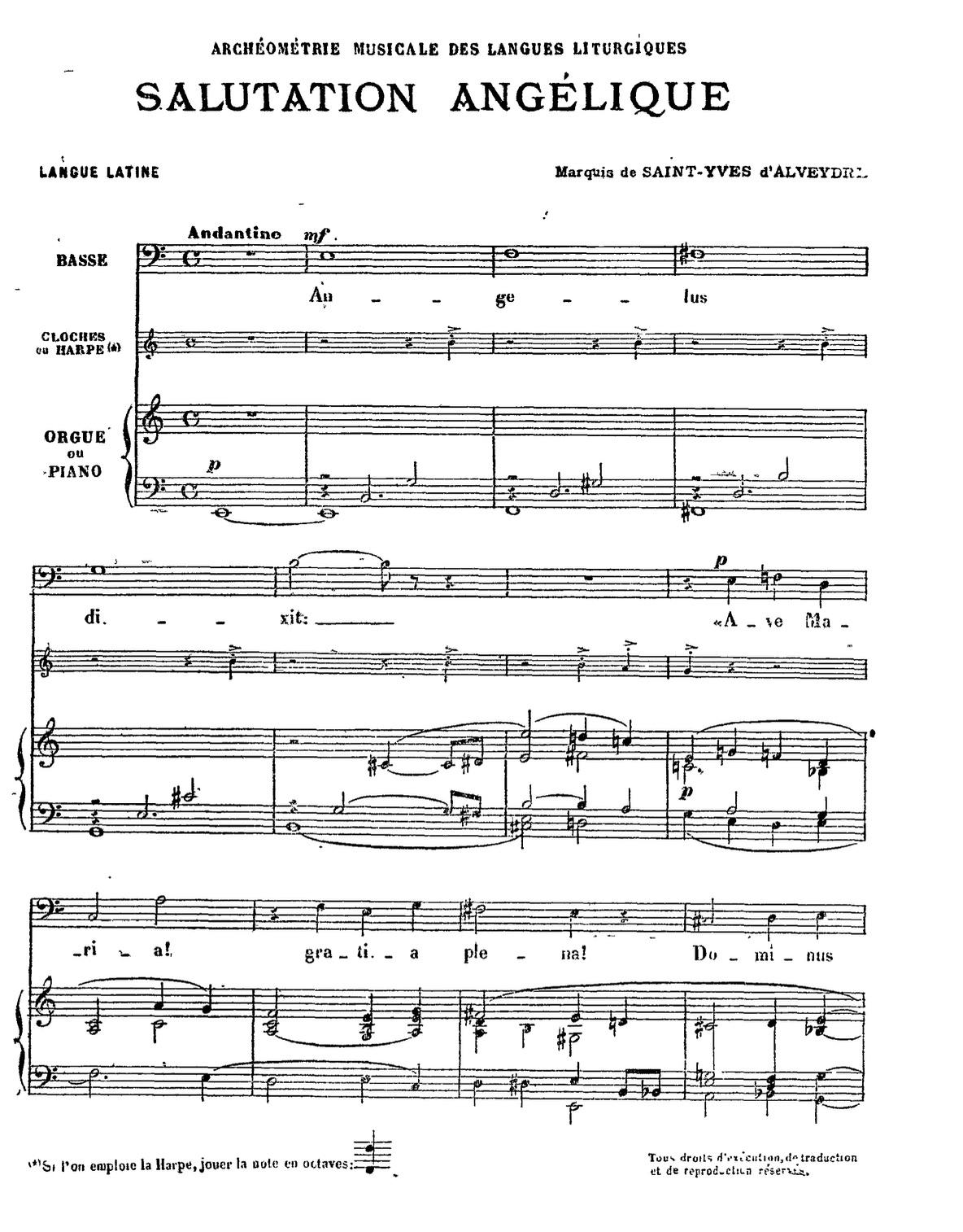
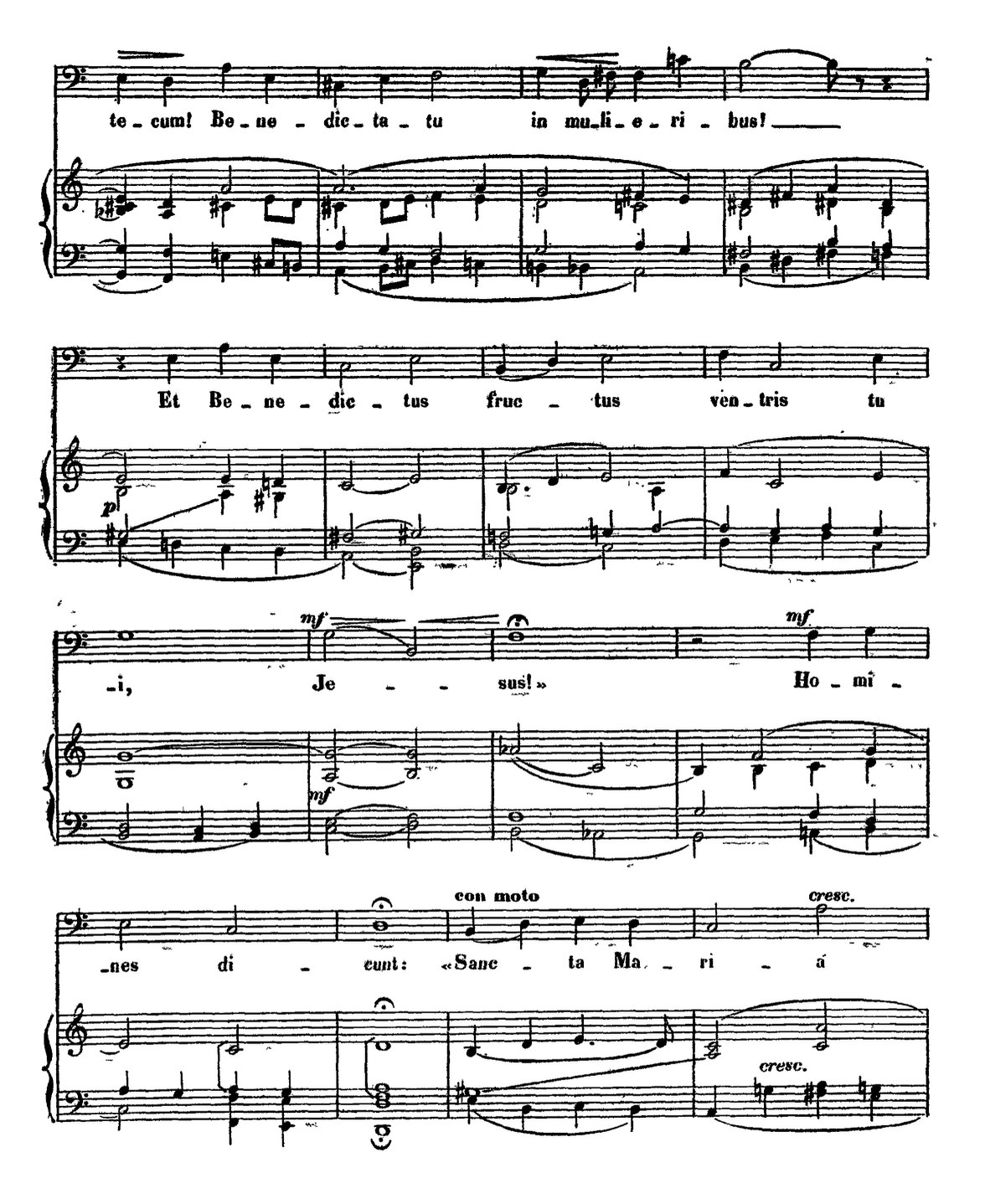
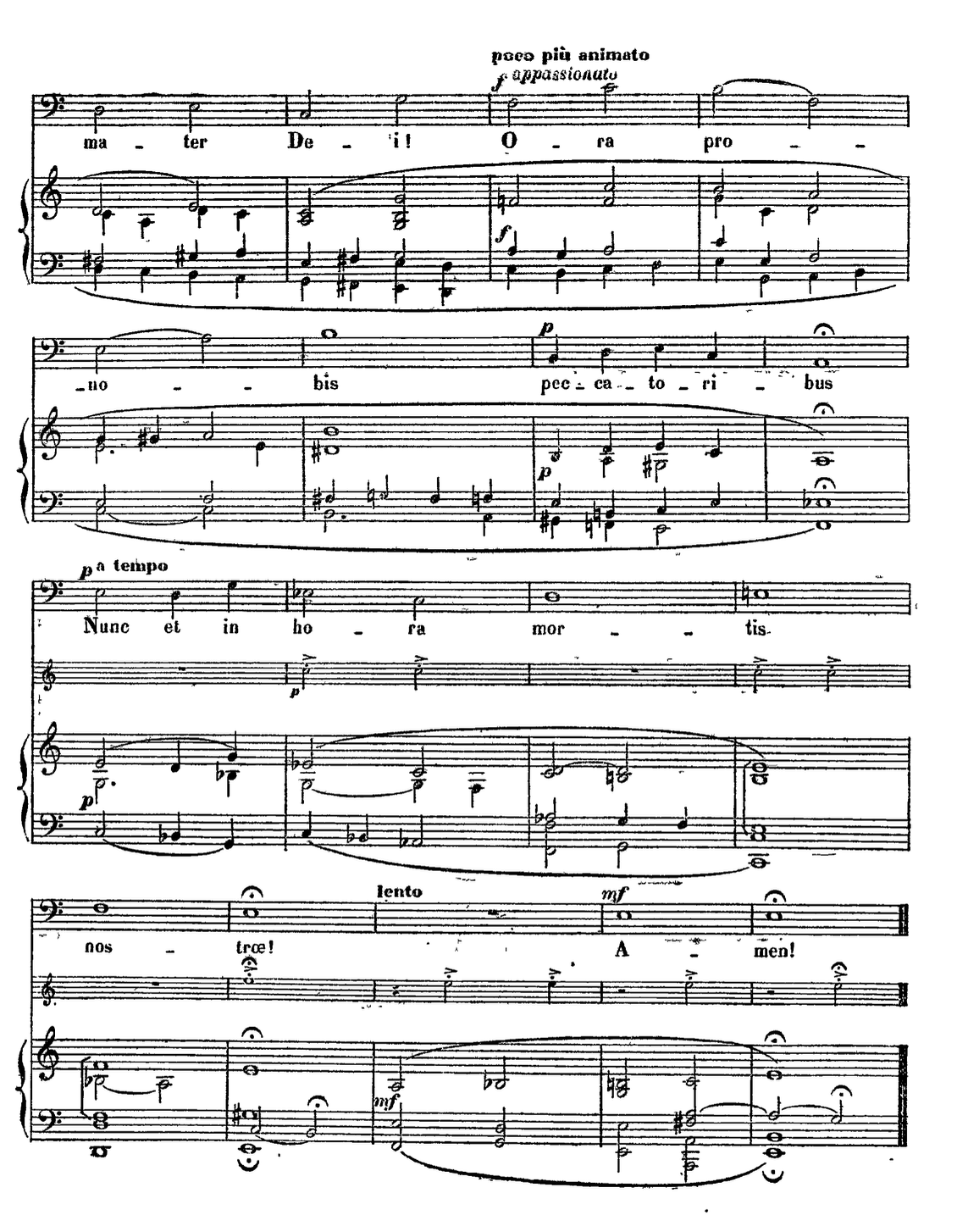

Thus the Archeometer has just furnished us with the musical system we must employ, which itself derives from that of the first trigone and the Name of the Word:
With harmony thus determined, all that remains is to read the melodic equivalent of the name we have chosen. The Archeometer responds: M = Ré, R = Ut, E = La.
Pronounced in the modern manner, this name yields the following harmonics:
I = Sol - harmonic of C as the fifth, of D as the fourth. — A is the ray or string that shall be chosen.
The Archeometer has just given us the musical numbers of the name we wish to construct and have pronounced by every aesthetic object entering into the sacred Edifice.
We now require the musical and modal series of these numbers, and finally their transposition from Arithmology to Morphology - in other words, from the language of Numbers to that of equivalent Forms.
THE STANDARD
- 1. SONOMETRY OF THE NUMBERS OF THE SACRED UTTERANCE, VERBAL SERIES, PHYSICAL SERIES.
- 2. STANDARD AND DERIVATIVES, — HEPTACHORDAL DIATONY.
- 4. OCTACHORD. — 5. SIMPLE CHROMATISM. — 6. DOUBLE CHROMATISM. — 7. MULTIPLE CHROMATISM.
We therefore resort to our second precision instrument: the Standard or musical rule of the Archeometer.
Here is its brief description:
It consists of a metric line of 1m44 marked transversely by divisions called intervals. These are specified by numbers bearing on one side the name Verbal Series, on the other the name Physical Series.
The verbal series is the language of Numbers, their universal music.
The digits of the Physical Series are their proportional inversion, permitting all possible calculations of vibrations.
This dual system, provided by the Archeometer, confirms that of physicists based upon simple numbers and upon their equally simple Ratios.
It thus accords with modern Science while simultaneously conforming to Christian Revelation, whose arithmological and arithmometrical references it bears to the Numbers 144,000 for musical Arithmology and 144 for corresponding Metrology.
The Metrology of the Standard follows the same progression as its Arithmology. It departs from the greatest length of qualitative mensural Unit, just as Arithmology departs from the greatest number functioning as qualitative unit of universality that verbally specifies the series.
A simple reading will show that this Standard assigns to the meter the string D-flat, and thus the entire verbal series of numbers perfectly aligns with the numeration and mensuration of the French system - a correspondence found in no other sonometric rule.
On all others, the Ut string and its rule are incorrectly equated with the meter, and the presence of the meter alongside this sonometric rule of C serves rather to hinder than to aid observation, experimentation, and calculation concerning sonometry from the twofold viewpoint of verbal/musical and physical/vibratory aspects.
The Standard shows that the exact position of the Ut string corresponds to 1m08. Thus D-flat at 1m000, and the Standard carries this division to 1m00.000. In turn, C at 1m080 and the Standard carries this decimal division to 1m08.000.
5 th Style or Grand Style. — CHAPEL OF MARY.
FRENCH REPUBLIC
NATIONAL PATENT OFFICE
PATENT OF INVENTION (1)
Dated 26 June 1903
XII. — Precision Instruments.
No. 333,393
3. — WEIGHTS AND MEASURES, MATHEMATICAL INSTRUMENTS
Fifteen-year patent requested[*] 26 June 1903 by Mr. Joseph-Alexandre de SAINT-YVES, residing in France.
Method of applying the musical rule to architechny, fine arts, crafts and graphic or plastic art industries, called: Archeometric Standard.
Issued 19 September 1903; published 23 November 1903 This invention concerns a method called: Archeometric Standard, that is to say a musical scale figured upon a rule allowing application to architechny, arts and crafts or graphic/plastic art industries of the mathematical rationale of simple or combined aesthetic proportions. The laws of this rationale are numbers, identical to those of music and harmony, but applied to proportional lines, forms, rather than merely to sonorous strings and sounds. This standard differs from other musical rules in that it satisfies the following conditions: 1° It is completely arithmological, that is to say armed with a double series of numbers forming a dual proportional rule intended for calculating aesthetic proportions. — 2° It is morphological through its intervals, each marked by a transverse line. These divisions of the string or line are motivated by corresponding numbers. — 3° It is metrological, in rational and speaking relation with the decimal metric system, the meter.
— 4° It is archaeological and archeometric, in rational and speaking relation with the Archeometer, of our invention.
This archeometer (see figures) is a precision instrument, cyclic protractor, cosmological codex for advanced religious, scientific and artistic studies. It consists of several concentric zones of equivalents comprising from circumference to center: a double zone of degrees; a double zone of letters; a double zone of numbers; a double zone of musical notes; a double zone of colors and a double zone of cosmological signs. Through its notes and musical numbers the archeometer is the generator of this standard. But notes and numbers have, upon the archeometer, other equivalents, as functional expressions of scientific rationale. The standard thus entails, through its exact relations with the archeometer, all possible applications of the latter to the arts, crafts and art industries designated above. Moreover, it lends to all other scales and musical rules, applied to the same uses, all or part of these archeometric correspondences.
(1) As the “Patent” relates principally to the Standards and their adaptations, we reproduce it here “in extenso.” ↩
The plate shows how musical rules are constructed, and what modifications this invention brings to them. It includes five rules, of which one is the meter itself: 1st, fig. 4, the archeometric standard; 2nd, fig. 5, the sonometric rule of the physicists, that of Ptolemy; — 3rd fig. 6, the French decimal meter; — 4th fig. 7, the rule of the tempered system; — 5th fig. 8, the rule of the Pythagorean system. The rules in figs. 5, 7 and 8 are provided with a median line f,
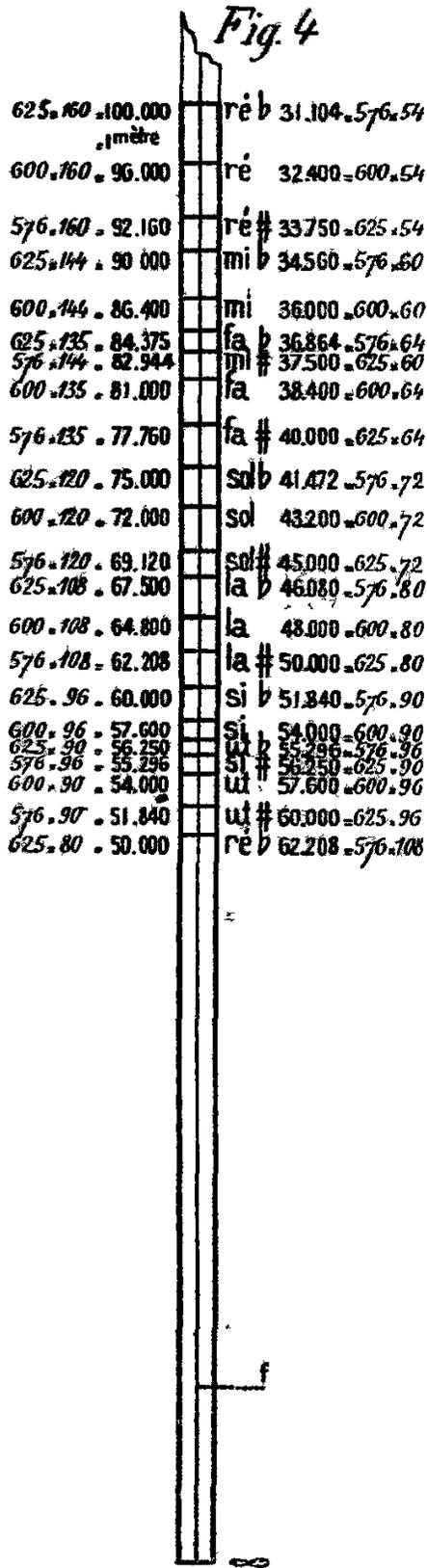
Archeometric Standard

Ptolemy’s sonometric rule

Meter

Rule of the tempered system

Rule of the Pythagorean system.
contains five rules, one of which is the meter itself: 1st fig. 4, the archeometric standard; — 2nd fig. 5, the sonometric rule of phys- an axis whose use will be explained hereafter. The rules in figs. 5, 6, 7 exist on all 13 sonometers, those of figs. 5 and 7 lacking arithmological series. Their musical scale shows that the rules in figs. 5 and 7 are referred to the Ut string, itself likened to the meter in fig. 6. The rule in fig. 5, that of physicists, the only one scientifically exact in itself, is complete regarding the Ut string furnished with 22 enharmonic intervals. It is not directly arithmological, since it bears no series of logical and physical numbers motivating its transverse divisions. It is not morphological in a direct manner, since the numbers motivating its aesthetic intervals are not present. It is not metrological, since the Ut string it represents is divisible by 9, hence by 6 and by 3, which the decimal system of the meter is not. It is therefore not archeometric, lacking these scientifically exact correspondences. The rule in fig. 7, that of the tempered system, fulfills these conditions even less; for it is inexact in itself, not to mention the aforementioned relations. It contains only 13 chromatic intervals instead of 22 enharmonic ones; and this chromatic series of C is itself inexact, a sort of rough compromise empirically conflating sharps and flats. The rule in fig. 6 is the meter divided according to the integrals 10, 100, 1,000, 10,000, 100,000. The greatest number, assigned to the whole meter, functions there as integral, as arithmological unit, qualitative, of numerical and arithmometrical universality. It represents the entire length measure, and, on sonometers, the entire Ut string — the fundamental sound called tonic. In the application forming the object of this invention, the string becomes the aesthetic line divisible into as many intervals or secondary lines as the integral number commands musical sound series. The meter thus has a logical sense, a definite qualitative sense, and not merely a physical or quantitative sense. When its integral commands its length by 10 at one extremity, the other extremity marks zero, the arrest of the series, and above zero it marks one decimeter—that is, the increment of the integral 10. Likewise for 100, 1,000, 10,000, 100,000. In this last case the in- tegral being 100,000 at the extremity we shall call grave; the increment at the acute will be 1/100.000 of a meter. And, in this application, it would be 1/100.000 of aesthetic line, if the meter furnished with this integral could be likened to a sonometer—that is, if among the 22 enharmonic strings there were one susceptible to the same integral: 100,000. When reading this number on the standard, fig. 4, verbal series on the left side, one sees that it commands the string and, in this application, the line D -flat. C is thus set back from 1 meter to 1 m 08, that is to say, to its enharmonic integral 108,000. This backward shift toward the grave, necessary as will be seen, thus gives the ratio C 108: D -flat 100 = 27: 25. All numbers in the scale of 22, verbal series, interlock thus without any exception or fraction, with the corresponding divisions of the meter. Consequently, the meter corresponding exactly to the string or to the line of D -flat becomes simultaneously a sonometer, and thereby an aesthetic morphometer, which would not occur without this invention, without this archeometric standard.
The advantage, whether of this direct application of the meter or of this correspondence, has great practical bearing. Scaling and fine-tuning are simplified and facilitated, not only for graphic and plastic compositions, but for their execution by the industrialist, contractor, or master craftsman. Moreover, as the verbal series commands the physical series on the right side by proportional inversion, the exactness of this standard, not only in itself as proportions, but in all its correspondences, allows for the rectification of sonometers as instruments of physics. Figures 5, 7 and 8 show that they correlate the length of their musical string with the meter, and this is correct if this string is D -flat, instead of C. But the sound of the metric string is itself, thanks to the tuning fork, a fixed sound, like the string itself, and not merely proportional. For example, the current tuning fork, based on the empiricism of musicians and manufacturers of musical instruments, is A 3, giving to its interval or string 862.2 vibrations, and consequently, to the tonic and to the string C 3 517.3. The mere reading of these figures shows they are empirical, and it cannot be otherwise, since scholars have halted the progression toward the acute, that of musicians, without regressing it to its exact correspondences. All treatises on acoustics and sonometry agree, moreover, in stating that this tuning fork is too high.
The relations of the standard with the Archeometer are: 1° the musical notes; 2° the diatonic numbers; 3° the correspondences between the diatonic and enharmonic; the correspondences of the double circle of 360° with the enharmonic scale of Sol. These relations entail those of all the equivalent series borne by the Archeometer. The relation of musical notes is self-evident and requires no demonstration. That of the diatonic numbers is fixed in correspondence with the letters R. 200 + M, 40 = 240, integral number of the Sol string, verbal diatonic series. The correspondence of the double circle of 360° with the enharmonic scale of Sol is fixed by this number 360 × 400, the number of the letter Th, the last of the arithmological alphabets employed on the Archeometer. These alphabets have 22 letters, which are 22 numbers, just as the enharmonic scale has 22 intervals, 22 strings or 22 lines commanded by 22 numbers. — 360 × 400 = 144.000, string of enharmonic Sol.
The logical sense of the verbal series corresponds directly with the metric sense, from the greatest number to the least. The sense of the physical series proceeds parallel, but inverted, from the smallest number to the greatest.
The axial line f, traced on the musical rules, fig. 4, 5, 7 and 8 represents the metric string, since these proportional rules are sonometers. But it also represents the aesthetic line, since these same instruments constitute proportional aesthetic rules. — In this case, a groove is arranged along the axial line so that the rule is perforated, allowing the point of a pencil or ruling pen to slide smoothly. Thus the artist, having chosen their musical intervals, can trace them as will be indicated, in proportional lines according to the numbers governing these intervals. Then, they need only combine these simple linear ratios, observing their arithmological, arithmometrical, and consequently morphological harmony. These rules may be of transparent or translucent substance, mounted or unmounted, like tempered glass or any other material. Moreover, these meters may be articulated musically so as to bend according to musical divisions. Finally, they may be sliding, like slide rules, so that each of the 22 intervals or their octaves constitutes a modal proportional rule according to its number. Lastly, these rules may be equipped with a mechanism allowing them to be combined into T-squares or polygons.
Having explained the construction of these rules, let us proceed to the application of the standard, an application that would be similar for all sonometric rules. This application is valid for architecture, for all arts and crafts capable of harmoniously entering into any monumental synthesis and accompanying or framing it, namely: ornamentation, ironwork, furnishings, cabinetmaking, frescoes, mosaics, glazing and stained glass, statuary, ceramics, goldsmithing, drapery, carpets, fabrics, linens, clothing, lacework, jewelry, gardens and parks, marblework, tombs, etc.
The four examples below, all in a single style, are: a chapel in elevation and plan, figs. 9 and 10; a chair, fig. 11; a cabinet, fig. 12; and a vase, fig. 13. For each example, the three melodic notes La, Ut, Ré, chosen on the Archeometer, fig. 2, and corresponding to the letters M, R, H, are predominantly adopted, without prejudice to their harmonic accompaniment according to the mode of their tonic. For the first position of these three notes, the tonic is La. The musical rule of La is therefore detached at its correspondence on the standard fig. 4 and adopted as the line and aesthetic rule (AA’-A’A) of height, see fig. 4 a. Then one takes its octave, its half, the line and rule (BB’-B’B) corresponding to this octave, and adopts it as width under the name of La 2. These lines or rules are reduced to a quarter in the four examples. Then sliding the pencil either in groove f or along these rules, one marks the intervals with points and lines. Take for example figs. 9, 10. It is the facade of a chapel conforming to the style given by the adopted notes, consequently by their intervals and lines. AA’ is thus the vertical string of height furnished with its intervals; its vertical direction proceeds from top to bottom, from grave to acute, from the largest intervals to the smallest. In this manner, the multiplication of octaves toward the acute increasingly narrows the intervals and allows for the delineation of the moldings in the lower part, the base of the columns, the door, etc. — A’A, the opposite side, is this same string or rule in the opposite direction. By the same process as for string AA’, one obtains the moldings of the upper part. This string, as the inversion of the first, yields its morphological harmonics, following the laws governing these same harmonics, expressed as sounds on the sonorous string. The horizontal lines, indicated by fine strokes, have been purposely extended to the intervals that generate them on these two vertical strings or rules, to better show these correspondences. The height proportions being thus regulated, one proceeds to those of width. Here again, a single string is employed, that of La 2, half or octave of the preceding, with the same inversion as above. The horizontal string or rule BB’, at the base, proceeds from left to right. The string B’B, at the summit, proceeds from right to left. Here again, and by the same process as above, the melodic lines are enriched by their harmonics. Finally, the overlapping of all these combined horizontal and vertical lines yields the musical graphic from which the monument is drawn. By this simple process, the work of art conforms to the scientific laws of proportion, since the morphology of these laws is the exact expression of their arithmology. The preceding graphic determines a genre, that of lines or strings at rest, which we call inert.
To animate this genre, one sets these strings or lines vibrating. In the chosen examples, the rectangle corresponds to the vibration of a semicircle. This is why each string, large or small, becomes the diameter of the circle of its vibration. These vibrations, like their strings, are musically proportional in themselves and in their combinations. One thus obtains, as with the lines or strings at rest, the morphological music of the whole and of all details within the whole. But the chord Ut-Ré-La, its numbers, its intervals, are susceptible to three positions, in accordance with musical laws. The examples in figs. 9, 10, 11, 12, 13 show only one, which suffices to prove the other two. As for the harmonic accompaniment of this chord, it is effected in its tonic mode, following the example adopted for demonstration, and the proportional lines resulting from it are obtained and treated as before.
Same manner of operation, same position, same style applies to the chair in fig. 11, the cabinet in fig. 12, and the vase in fig. 13.
The 22 intervals of the scale of forms or proportional lines of beauty, following the same arithmological laws as the 22 sounds, have, like them, an almost infinite number of possible scientific combinations. It is therefore this entire new resource that this application of the musical rule brings to architecture and to all the fine arts and crafts named above.
The preceding examples correspond to artistic composition. As for execution by labor and industry, the reduction to a quarter, noted above, allows one to appreciate the simplification these instruments bring to any scaling, however great, especially given their exact relation to the meter through the archeometric standard. 95 Concerning the musical correspondence of colors with forms, one may read it on the chromatic Archeometer in fig. 1:
H, la = violet: blue 60red 60;
R, ut = orange: yellow 60red 60;
M, ré = green: blue 60yellow 60;
and so forth for all the other 5 notes and archeometric correspondences. Figure 3 represents a 120° protractor, printed on transparent or translucent substance. This protractor serves to determine the exact harmonic proportions of fundamental colors that must enter into a mixture answering to a desired harmony. This protractor is placed upon the chromatic Archeometer fig. 1, center upon center, so that its two extreme radii bisect the angles and polygons of the two fundamental colors whose mixtures one wishes to ascertain.
By proxy of: DE SAINT-YVES.
MAULVAULT.
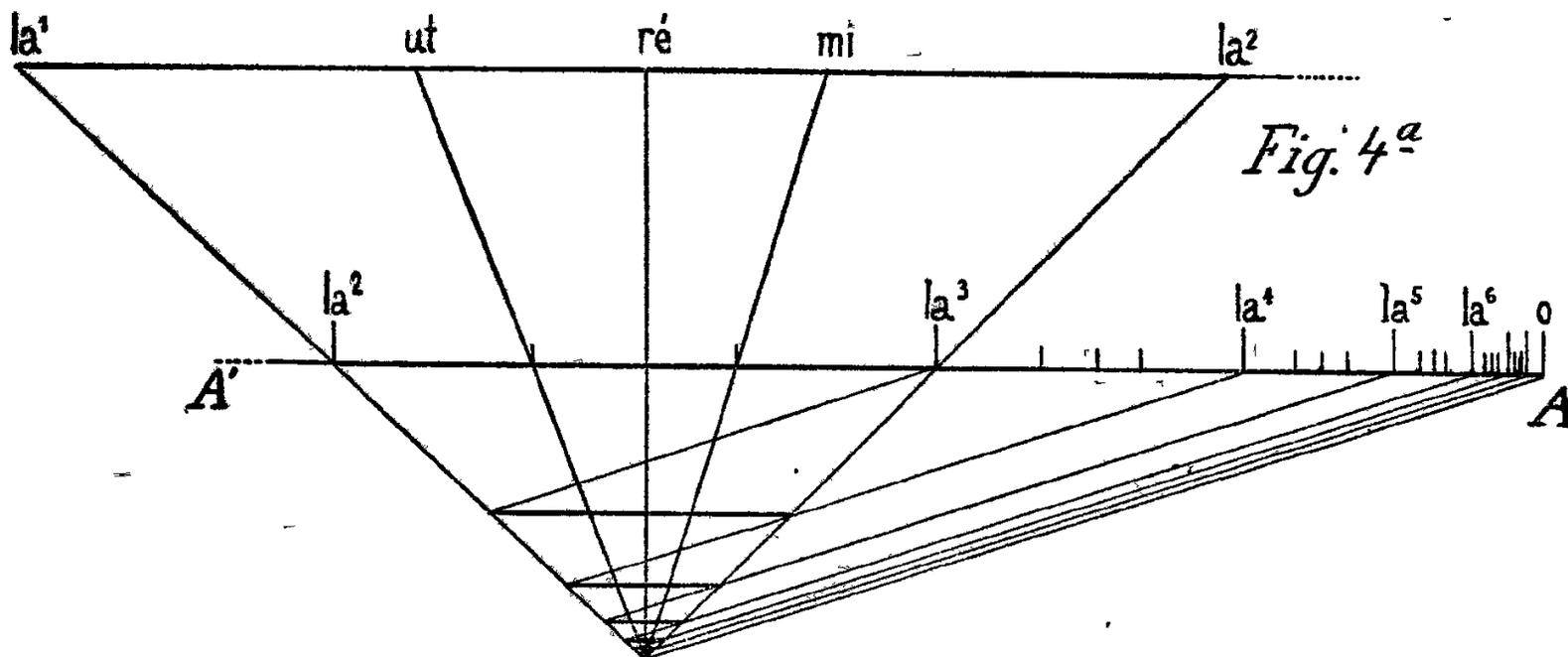
Application of the Standard to Architecture, string of La.
All musical Arithmology is thus in exact correspondence with the French decimal and metric system.
The Standard of the Archeometer is, to this extent, capable of reducing to the Unity of its Universality all the systems of the world, but we must limit ourselves here to the application that is the object of the present exposition.
As the Number verbalizes the Interval and the latter the Form, one will readily understand how we shall transpose the nominal melody and harmony of the arithmological language into the morphological language.
We read on the Standard the number 240 at the head of the valid series:
240 generates a scale of XII sounds, VIII diatonic, IV chromatic; and it is specific to the string of Sol which corresponds to the letter I.
Immediately after 240 G comes its diatonic second. La 216 which shall be one of our strings.
We then find at 180 C and at 160 D, our two other strings.
Thus we have the harmonic series determined by Melody, concerning both diatonic and chromatic genres.
But if one wishes to employ, instead of VIII and XII musical numbers in the scale, all those of the trinary system called enharmonic, one will read this enharmony on our Standard with equal facility. It results from the multiplication of each natural diatonic number 1° by 600 = 24 × 25; 2° by 625 = 25 × 25 to obtain the flat; 3° by 576 = 24 × 24 to obtain the sharp.
This is why one reads on the verbal series of the Standard:
La 216 × 600 = 129,600
Ut 180 × 600 = 108,000
Ré 160 × 600 = 96,000
and so forth.
The corresponding divisions of the Standard allow the employment of all possible musical genres—diatonic, chromatic, enharmonic—and their transposition into the language of Forms through equivalent intervals:
The number 144,000, the only one that can give the enharmony of the Sol string, is liturgical in the Christian revelation. It is that which Saint John assigns to the celestial musical system as its arithmological seal.
The number 144 is that which he assigns to the unit of morphological measure. This is why the Standard bears this reference of 144,000 as arithmology and of 144 or 1 m. 44 as metrology.
We have not sought these correspondences between Science and Religion—they presented themselves spontaneously upon our Archeometer and its Standard.
XXII Letters of the sacred Utterance.
XXII Numbers » » XXII Metric Intervals » XXII Sounds in the enharmonic scale.
XXII Corresponding colors.
… etc. etc…
Such are the five Alphabets of the five languages of the sacred Utterance that the Archeometer and its Standard permit us to apply to Architecture and all aesthetic Arts and Crafts.
The enharmonic combinations of beauty with which we thus endow the Arts amount to a formidable figure.
5,842,387,018,385,982,521,381,124,421.
It would require 9 sextillion years at 12 hours of work per day to write them in musical notes.
But in the language of logical Forms, which we constitute here, one must further cube this number of possible combinations of the musical alphabet of forms; and even the cube only suits the simplest polygonal Morphology.
Yet the fecundity of archeometric science, applied to Art, does not stop there.
The Standard, on its metrological line and through the combination of the XXII musical strings it contains, only yields the harmonic morphology of rectilinear and polygonal forms. This is what we shall call the crystalline architectural genre or musical carpentry.
But we set these lines vibrating like so many harp or zither strings.
The strings or lines, simple or combined, are thus musically furnished with arcs proportional to the morphological Species that commands the series and to the different styles it comprises.
All ornamentation is thus specified according to the species and its different styles, and there is nothing that is not concordant, logical, harmonic, from the whole down to the smallest detail; nothing where the Word does not give to the human Spirit the exact cause and reason of all beauty and all harmony of beauties. This is what we call the living or organic genre, the transformation of inert crystalline into animate.
This is why opposite the verbal series of numbers is found the physical and inversely proportional series of numerals that allow the calculation of vibrations, in the case where one would wish to use our Standard as a sonometer.
Concerning morphological vibration, we render aesthetic work as exact and simple as possible by the law we have formulated above; the Arc is proportional to the Species and to the different styles it comprises.
Examples will soon make what precedes understood.
Beforehand, it is not irrelevant to show with superabundance that the equivalence of Form and Number is a fact and a law of the Word.
The Standard has already proven this to us through the equivalence of Intervals and Numbers, but the vibrating plates will corroborate this proof.
1° Equivalence of the Circle and the Zodiacal number XII.
Take a circular plate dusted with well-leveled lycopodium powder: vibration will reveal a system of forms called Antinodes and Nodal Lines, marked by the duodecimal number and its multiples. The equivalence between the Zodiacal number XII and the Circle form thus asserts itself as a legislative utterance of the Word.
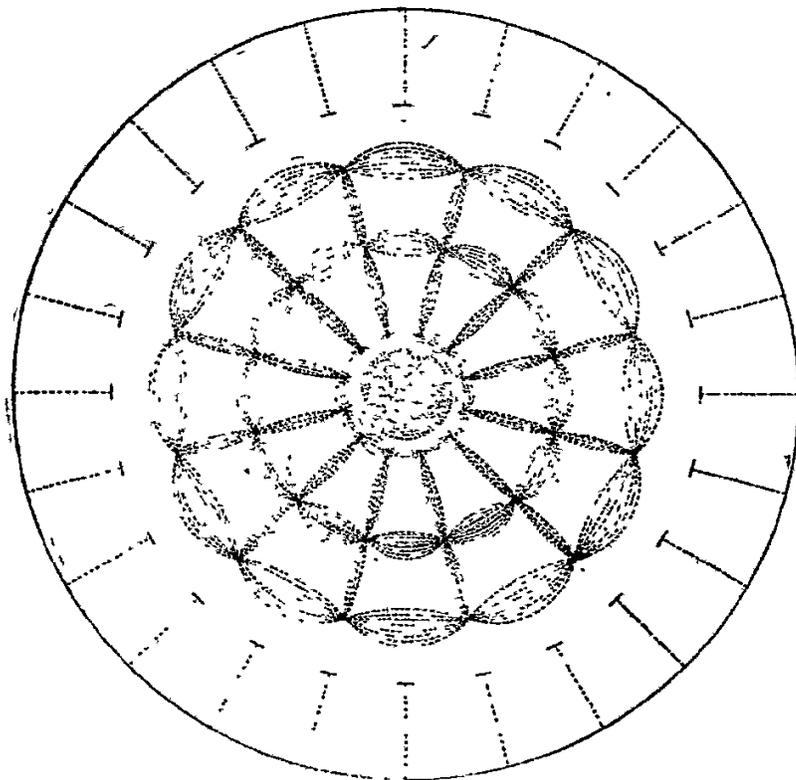
Vibrating plates.
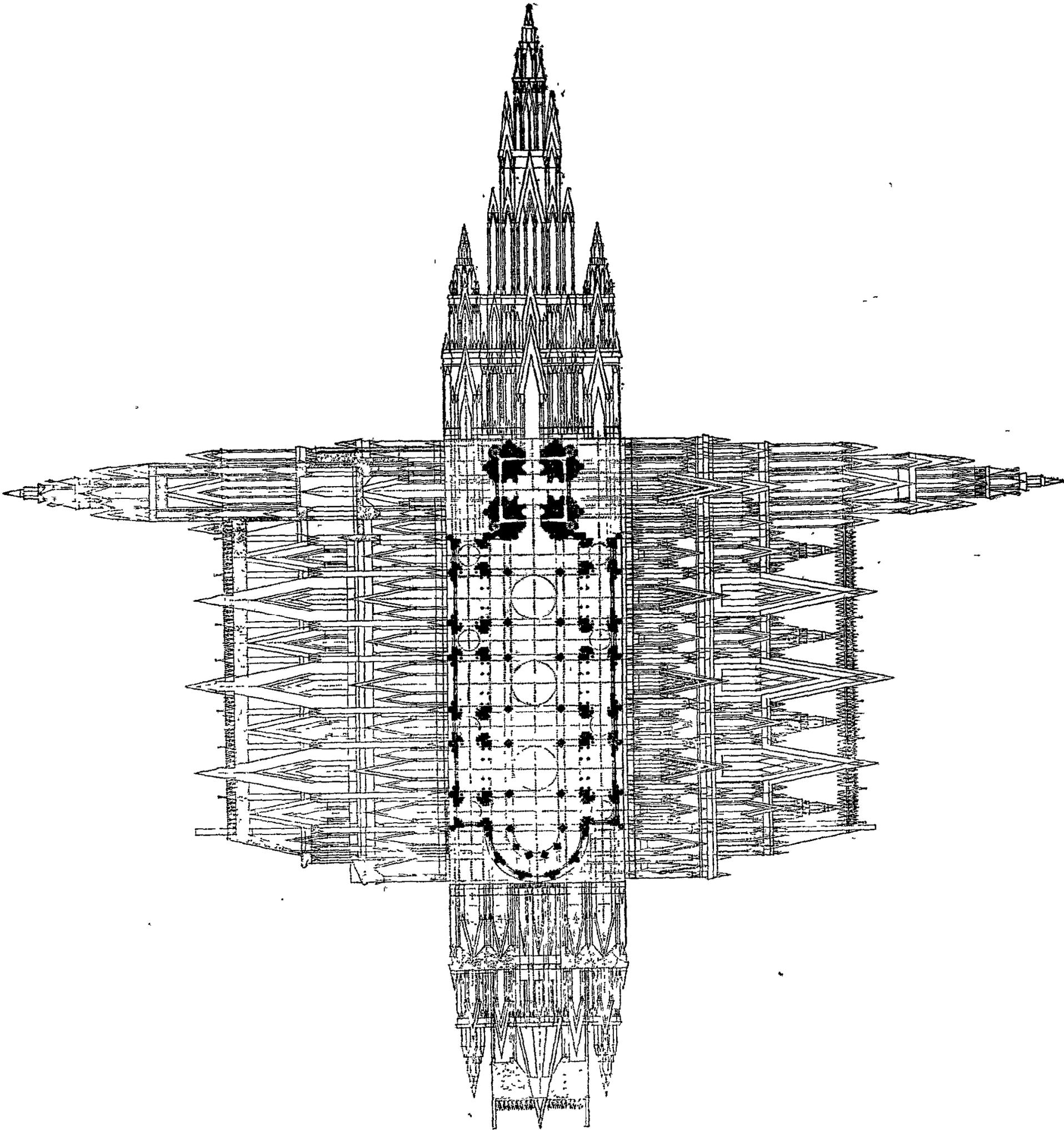
CHURCH. — Musical carpentry of floor plans, sections and elevations.
Even a water droplet (see fig. p. 298) considered as a circular surface shows, under the influence of frost, a polygonal crystalline system ranging from the equilateral triangle to combinations of two, then four trigons of the same nature, whose angles are successively positioned at 180°, 60°, and 30° from each other. This defines the Zodiacal Circle through inscribed regular Polygons.
This is why we have adopted in our Archeometer the Zodiacal form for the Circle, and equilateral triangles to define this form.
This is the verbal principle of Morphology and Architechny revealing itself in these facts or graphic representations of Laws. The form here, as always, functions through numerical equivalents.
Now consider a vibrating plate in the shape of an equilateral triangle. It is equivalent to the number 3 as the circle is to the number 12.
Following the law of numerical interiors, 3 contains 2 + 1 which, added to itself, gives 6. The vibrating plate of the equilateral triangle indeed produces 6 hexagonal stars. The interiority of 6 added to itself gives 21. The same vibrating plate also produces 21 circles, semicircles, and third-circles.
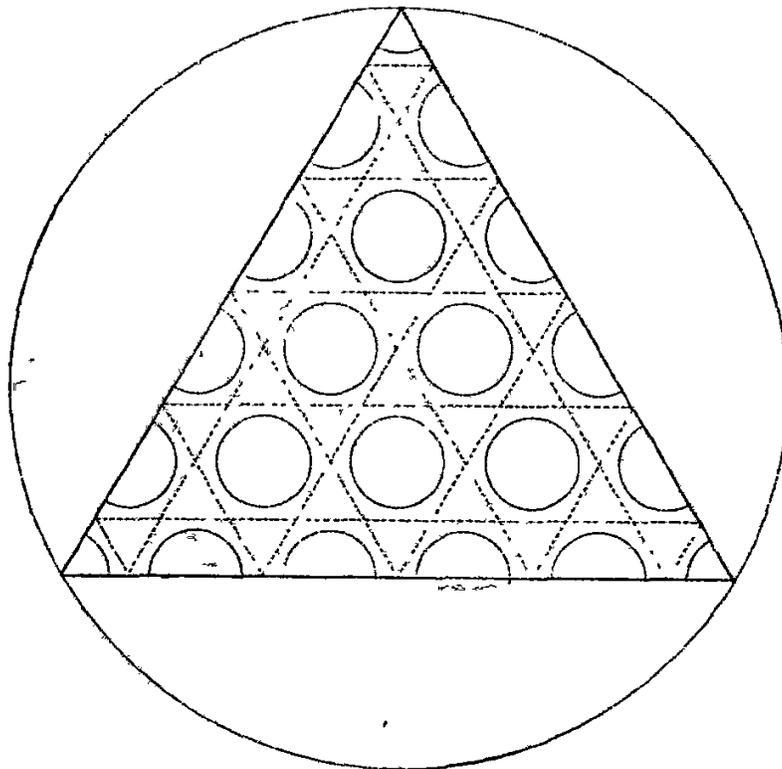
These examples suffice to prove the equivalence between Arithmology and Morphology, and the scientific value of our Archeometer and its Standard when applied to Architecture.
Let us return to our demonstration.
The 3 melodic modes of the name Mary are susceptible to 3 positions according to known rules of Music, but these sounds possess this triple verbal quality only through numerical functions.
| 1° | 216 | 180 | 160 | — | (54 | 45 | 40) |
| 2° | 180 | 160 | 108 | — | (45 | 40 | 27) |
| 3° | 160 | 108 | 90 | — | (80 | 54 | 45) |
For simplicity and ease of demonstration, we shall adopt here La 1 216 over La 2 108, it being understood that within this octave interval, those of the minor third Ut 180 and the fourth Ré 160 will articulate the other letters of the name.
Thus we shall take one of the 3 positions as an example, and this will yield us 5 styles.
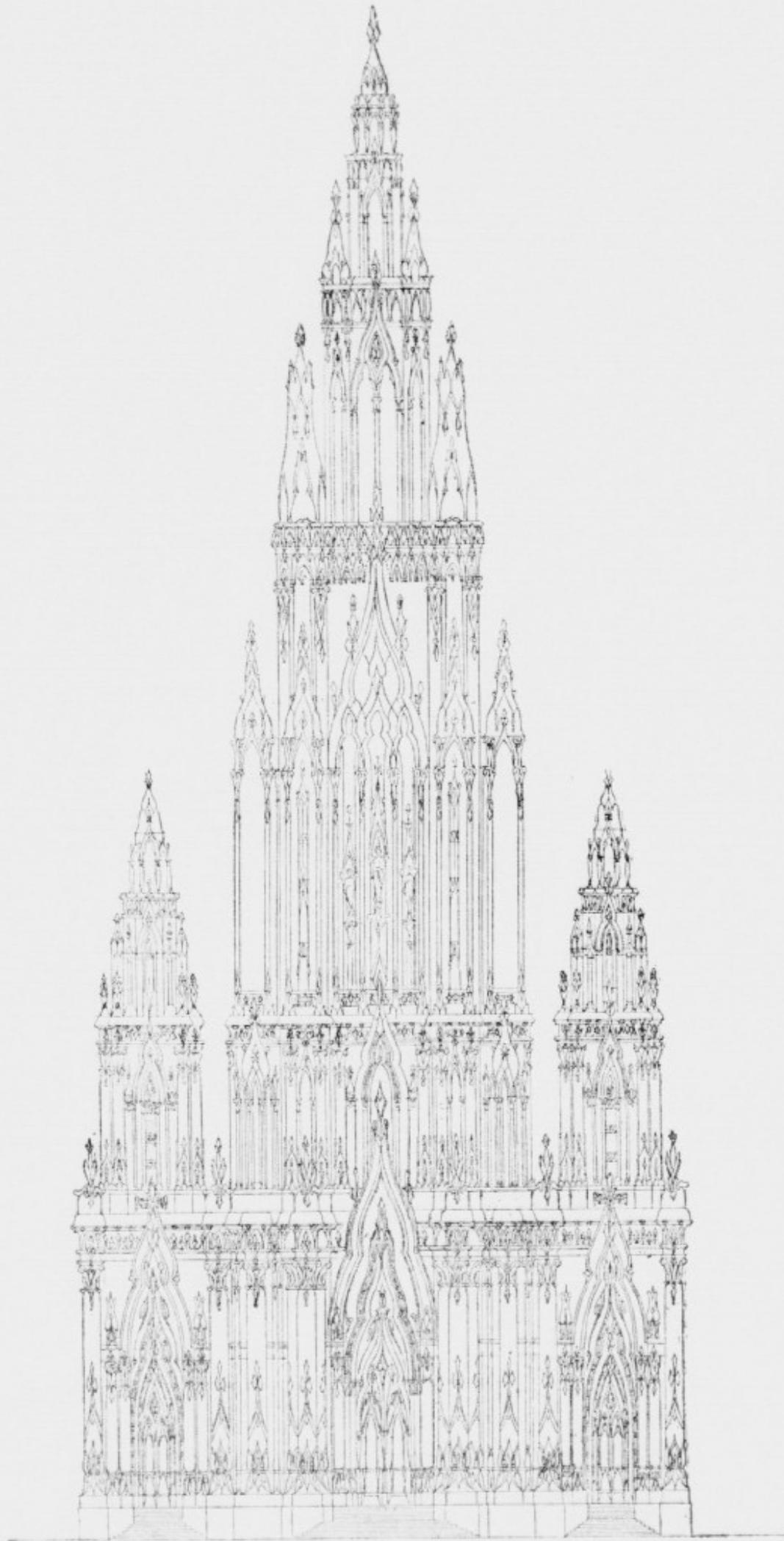
CHURCH. — Main facade.
We shall therefore detach from our Mother-Rule two secondary rules or strings: La and its octave.
We shall then arrange them in a T-square, having graduated them in modal series according to the Standard and its diatonic system.
The octave 108 will serve as base, horizontal line and width; the full string will serve as height and axis of symmetry. Note that our uncombined strings are triple.
One yields the adopted scale, another its inversion which allows the corresponding morphological harmonics - the consonants - to be marked. Finally, the central metrical string or line gathers all these intervals which resonate like when one
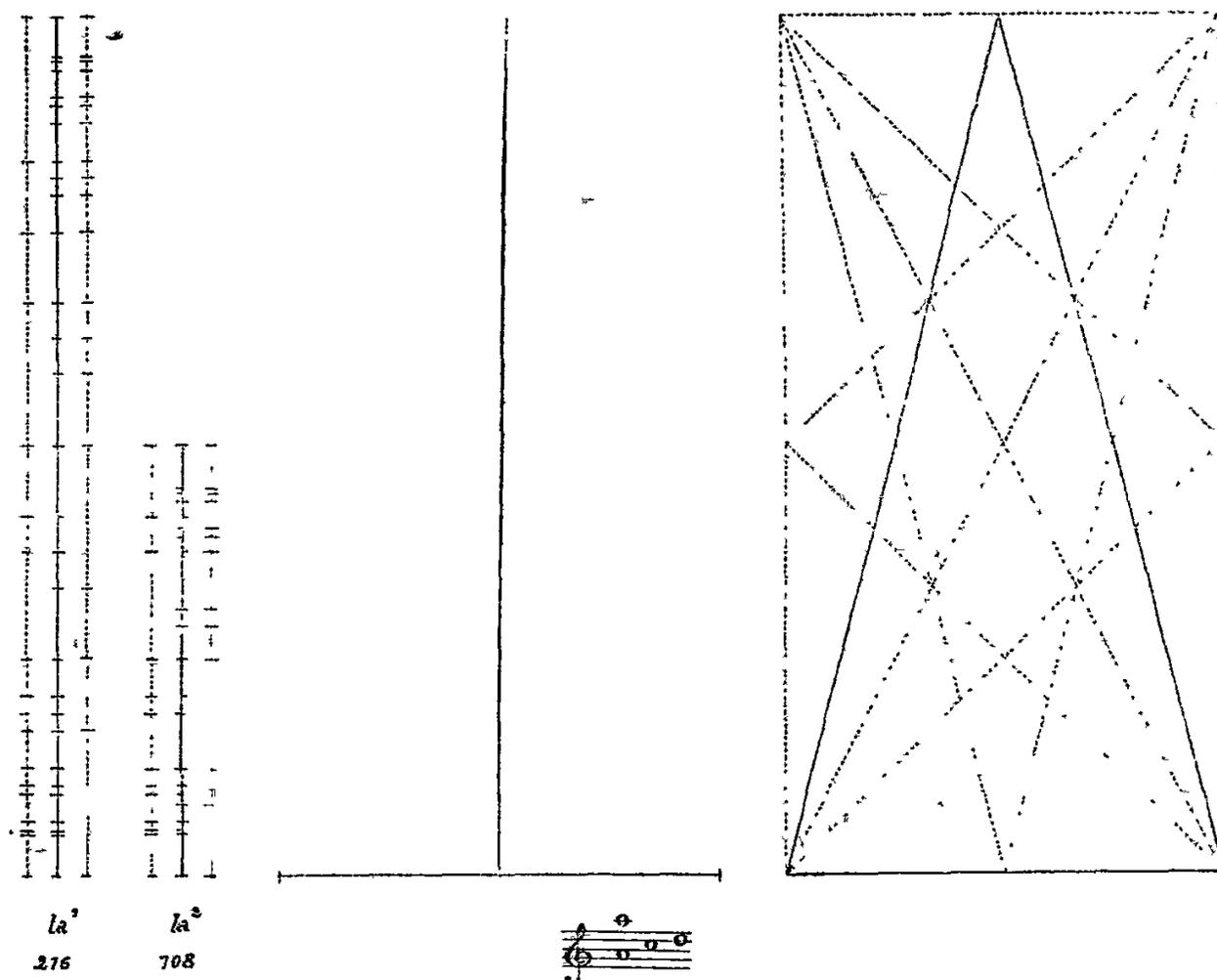
brushes with the fingertip the strings of a zither at the morphological point where names awaken consonant harmonic sounds.
From these simple premises, the musical species adopted by us—that is, La 1 over La 2, 216 over 108—will generate five genres or styles.
We have seen the strings or metrological lines generate the T-square, which in turn generates a quadrilateral, and this finally yields five different triangles.
These five triangles, which we call pediments, generate our five styles—two of which, being very similar, mark the Greek style. Hence, as these two styles are nearly identical, we provide but a single example.
1 st style… It marks the Greek without imitating it, for our method eliminates even the possibility of imitation, by virtue of being directly logical, verbal, and systematically musical. The cartouche placed beneath the edifice denotes its style. The first figure presents the musical carpentry according to the inert crystalline genre assigned by the base and height common to all four examples, with the specific difference of triangulation marked on the cartouche.
We need not record here the musically derived proportions, as they are readily discernible from the example itself.
The Ut string and the Ré string sing their music of forms at the points marked on the rule, while the harmonic mode of La accompanies and resolves this melody.
The adjacent figure illustrates the transition from this crystalline genre to the animate genre, made possible by combining circular arcs or vibrations conforming to its triangulation.
3 rd style — same observations 4 th style — same observations 5 th style — same observations Thus with a single position, we obtain five styles, and we may employ the three positions to yield 15 styles. We also indicate the augmentation of octaves on the vertical string, which allows each style to be heightened, if not further multiplied. We further note that the same subject, treated inversely according to the same principle and laws, can render the pronunciation of the same name in secular architecture—villas, castles, mansions, palaces—bringing us to 30 styles for a single species specified by one name.
Upon close study of these examples, one cannot fail to observe how the animation of sacred elegance and exaltation ascends gradually from the first style to the fifth.
Just as the first two mark the Greek, the third marks the Romanesque, the fourth the Gothic, and the fifth transcends what existed as aspiration and inspiration in the classical forms of the preceding three.
Moreover, after the Greek—which resembles the infancy and stammering of architectural art—we see the other three styles employing the column, though quite differently. Here it is no longer an ornamental awning foreign to the edifice, but an architechnical organ of actual support;
In the classical system, the corona and entablature alone constitute the order of architecture. Yet they belong neither to it nor to the construction of which they are inseparable. But this same order, variable in our system according to the infinity of its Species and their styles, becomes an integral part of the architectural whole and of the entire construction. This is already visible in our third style and increasingly so in the fourth and fifth.
ARCHEOMETER-REGULATOR
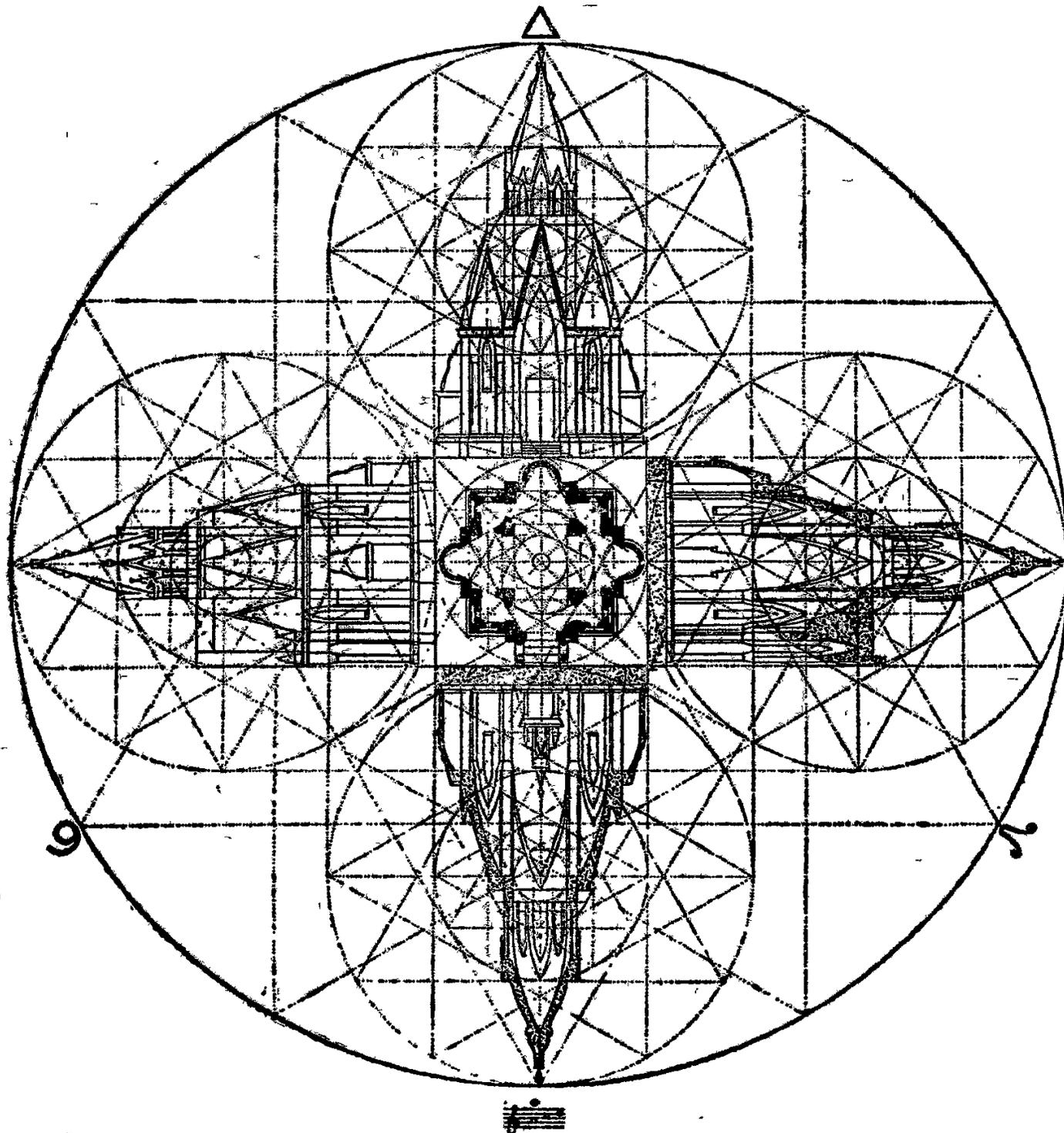
We did not wish to interrupt the application of our Standard. But before transforming the strings of the crystalline genre into the living genre through proportional vibrations, we further verify this harmonic carpentry by placing it upon the Archeometer.
Here is the description of this verification, to be followed on the corresponding figure.
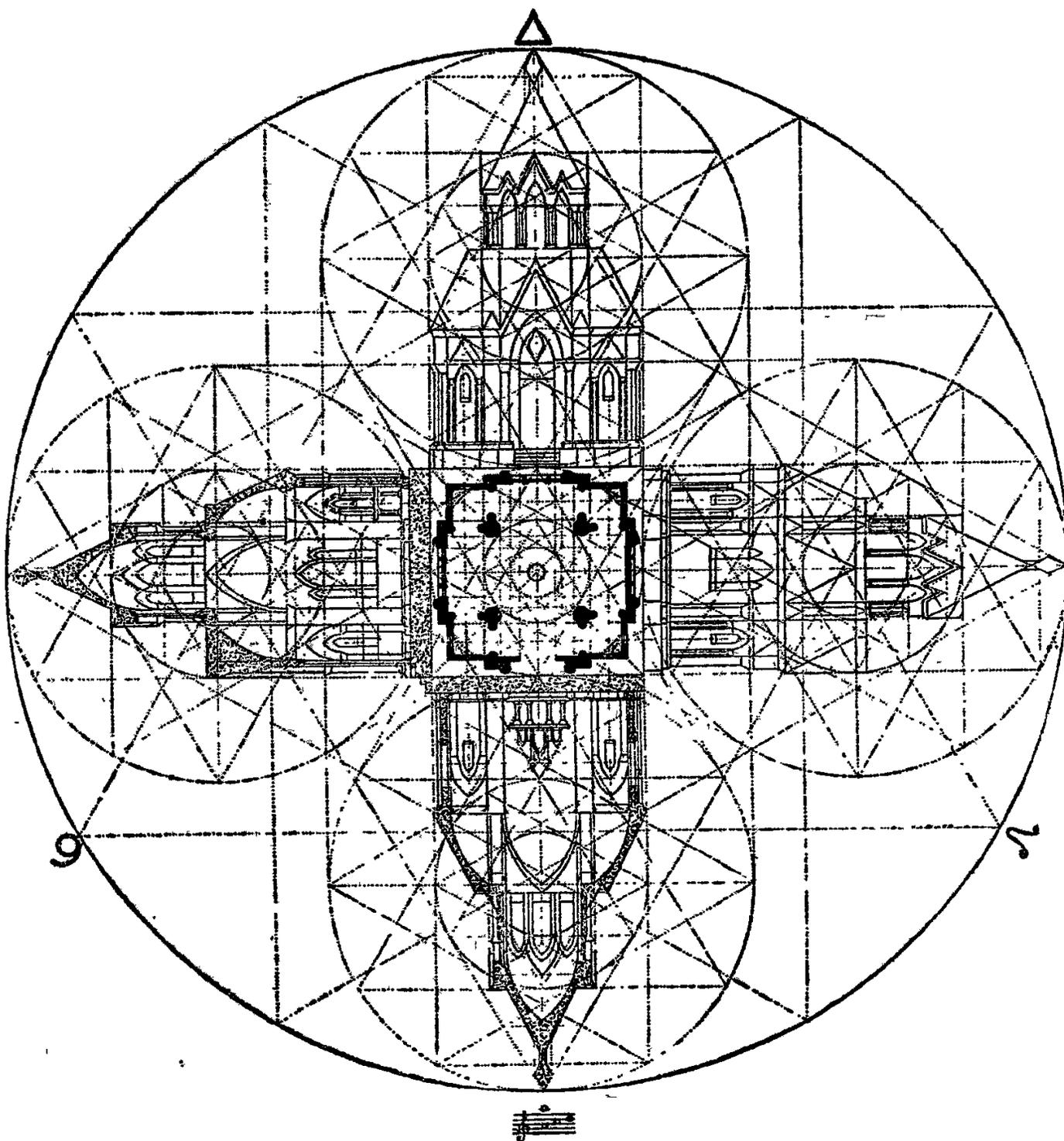
4 th Style (Neo-Gothic). — CHAPELLE DE MARIE.
The plan occupies the central portion of the archeometric circle, so as to develop the edifice in two elevations and two sections.
- 1° The north facade elevation;
- 2° The south rear elevation;
- 3° The eastern end section;
- 4° The western lateral section.
In this manner, one achieves complete verification of the harmony of the entire edifice and all its parts relative to the plan.
Lastly, the small inner circle at the center of the plan indicates the module.
But this applies not merely, as in Greek art, to external ornamentation designated as the order—that is, to the column and entablature of an awning or peristyle.
Our module suits the entire musical Edifice, inseparable from construction, and every member of this harmonic synthesis of forms.
Thus, after employing the Archeometer as Revealer, we further use it as regulator.
We provide but a single example of archeometric verification, to avoid unnecessarily lengthening this description.
The Archeometer-Revealer has furnished us the correspondences of the Name of Mary, musically and morphologically pronounced in chapels through transpositions upon the Standard. Likewise, these two precision instruments yield one of the cathedrals bearing the same name.
By the same principle, laws, and Instruments, we thus obtain a cathedral of the Word Jesus.
To this we add an abbey church created in the same manner, though without concern for the Utterance, to demonstrate that we may employ the musical Language of Forms directly.
Yet by virtue of being an equivalent Language, it provides in this example a nominal reference.
It is understood that these cathedrals and this church represent but one of fifteen examples we might furnish for each, not to mention fifteen other semi-secular monuments such as pontifical or episcopal palaces, seminaries, universities, schools, hospices, convents, religious theaters, etc.
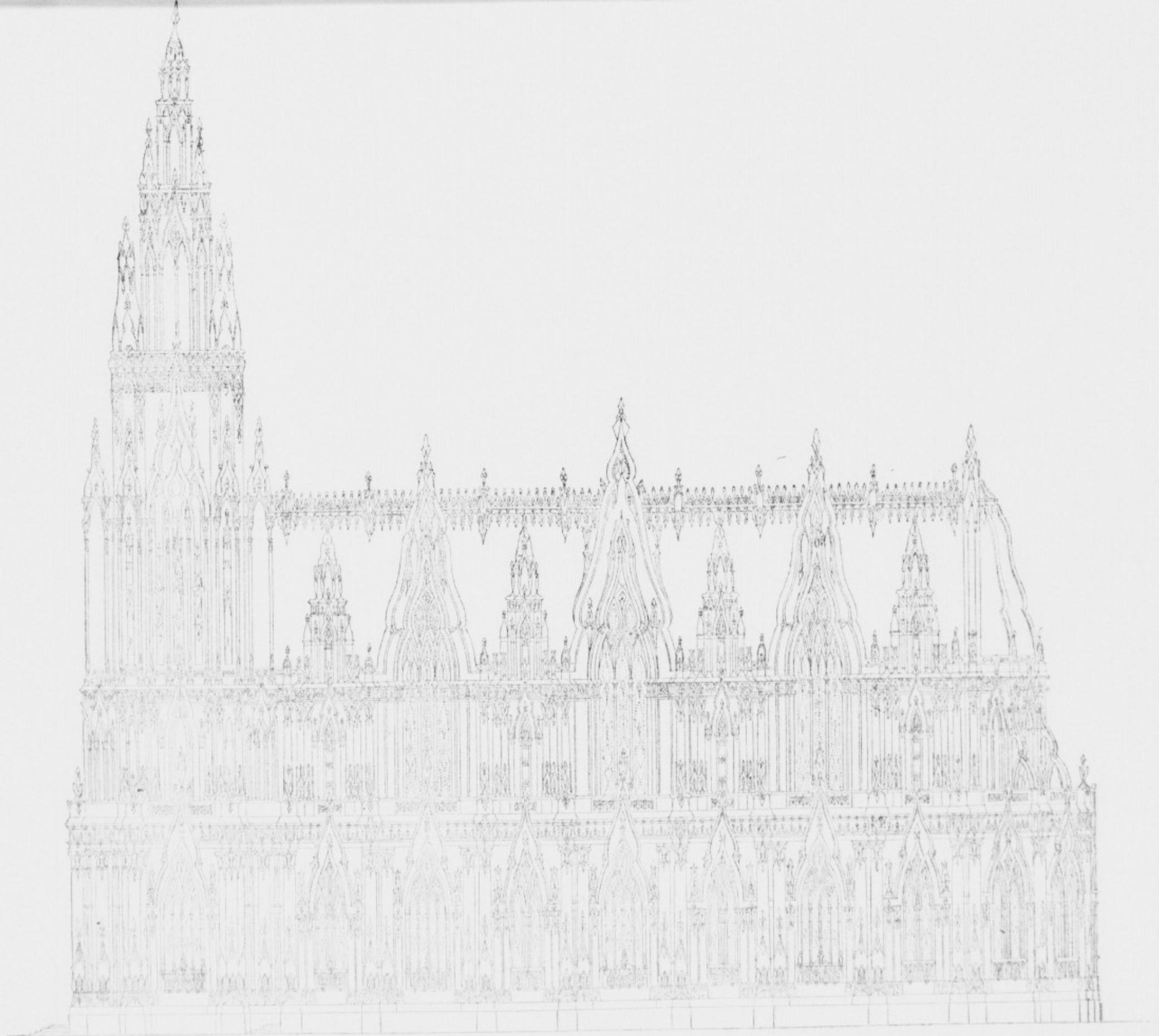
Church. — Lateral facade.
The second is that Chevreul’s chromatic circle does not provide pure colors, but rather tones subdued by successive and proportional mixtures of white and black.
The proof of color-form correspondence is demonstrated through rotation.
If one rotates Chevreul’s chromatic circle around its center, it will show
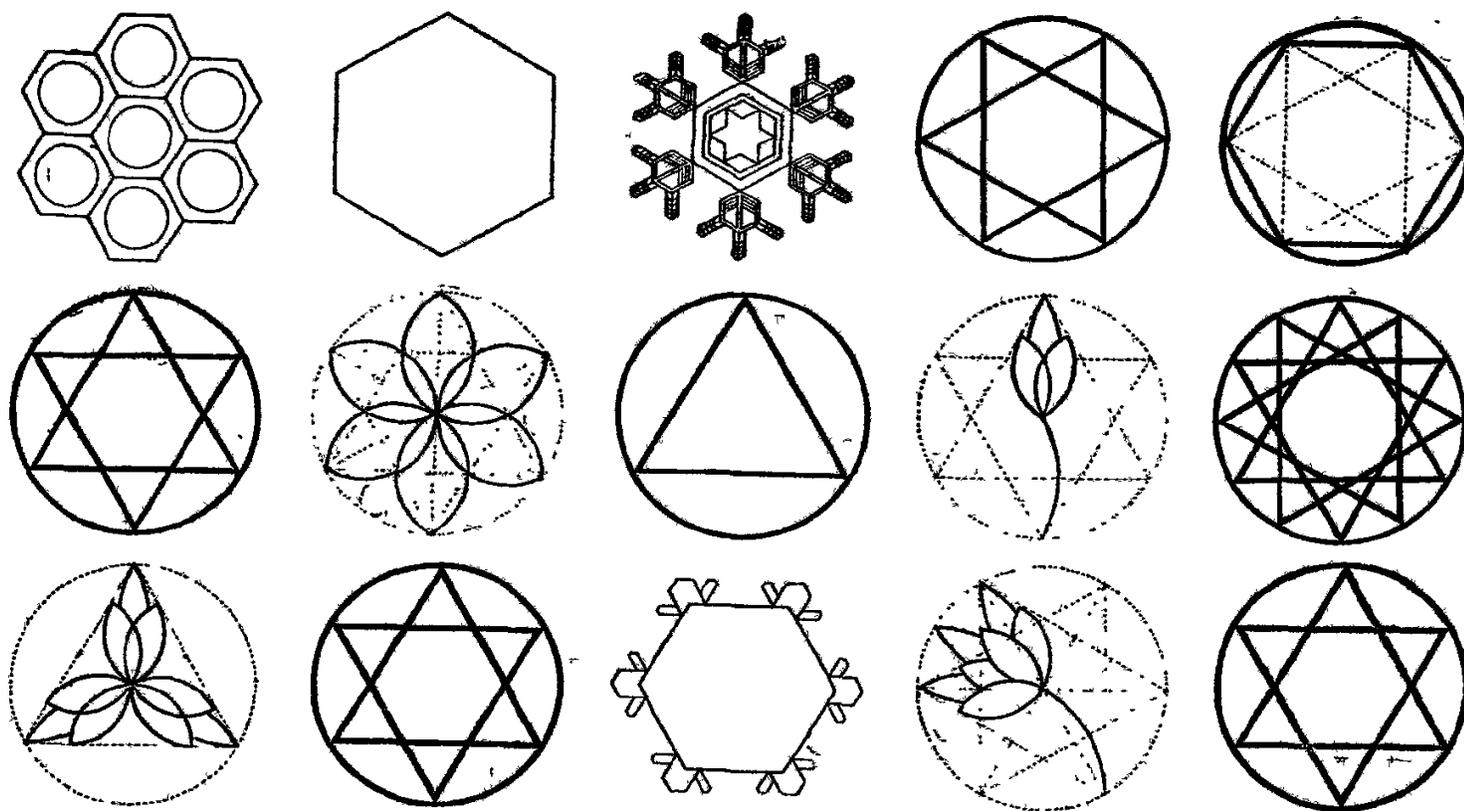
Various Crystallization and Natural Morphology (See p. 289).
like Newton’s disk, the mutual cancellation of all colors, resulting in a grayish white.
Conversely, if one rotates the chromatic Archeometer, one will see the colors musically composing with each other, mutually intensifying; and upon this background, the photogenic ray—the yellow—asserts itself with a power it did not seem to possess when the archeometric circle was at rest.
Equipped with the first northern triangle whose angles are positioned at 120° from each other, the Archeometer thus provides the trinitarian, chromatic and chromometric Principle: Blue, 120, Yellow, 120, Red, 120.
Equipped with both northern and southern triangles, it yields these three colors plus their mixture in equal parts according to three pairings and positions:
Furthermore equipped with a pair of eastern and western triangles, it provides the mixture of the three primary color pairs in the proportions of 30/90, 60/60 and 90/30. These are the zodiacal colors.
Vases
As for objects that may enter the sacred Edifice in morphological consonance
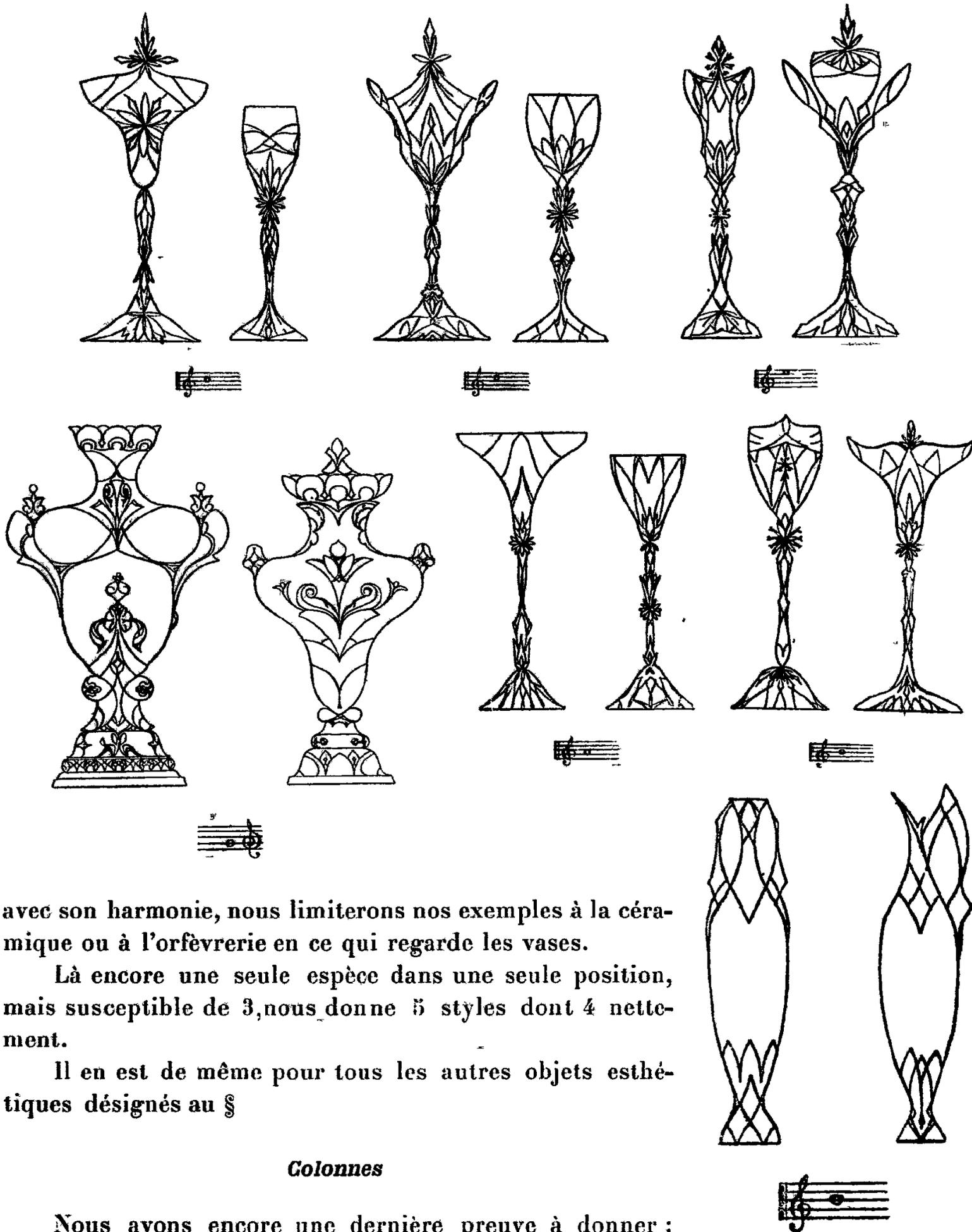
with its harmony, we shall limit our examples to ceramics or goldsmithing concerning the vases.
Here again, a single species in a single position—though susceptible to three—yields us five styles, four of them distinctly.
The same holds for all other aesthetic objects designated in §
Columns
We have one final proof to provide:
the derivation of the column and intercolumniation according to the same system and in conformity with the module of the whole.
The examples we present refer to the Abbey Church.
CHROMOLOGICAL ARCHEOMETER
- 1. Chromology of the sacred Utterance, the Three colors.
- 2. The Hexad of divine Solstices.
- 3. The Hexad of angelic Equinoxes.
- 4. The undulatory Synthesis complementing radiation analysis.
- 5. Archeometral chronometry.
- 6. The scales and modes of chromatic music: Diatonics.
- 7. The scales and modes of chromatic music: Chromatics and Enharmonics.
To obtain the Language of colors equivalent to the various functional signs of the Utterance, we employ two instruments:
- 1° The chromological Archeometer;
- 2° Its protractor, section of its degree zone.
The chromatic and chromological Archeometer conforms to Chevreul’s system regarding the succession of colors on the chromatic circle, but differs in the following points:
Chevreul’s chromatic circle does not show color generation through surface overlays nor through mathematical proportions. It cannot do so because it assigns to these same colors, as geometric correspondences, radii rather than inscribed polygons.
Now, the radius is metrically correspondent with the circumference only approximately, not morphologically. Alone, it does not generate forms; it does not make the circle speak. Thus to obtain the approximate law of π one had to proceed empirically through inscribed polygons.
To obtain morphology—the utterance of forms—within the circle, one must resort to the correspondence between the radius and inscribed regular polygons. One must therefore take as model the water droplet and its crystallization.
The first polygon that yields this Utterance is the hexagon. Its analysis is performed through two inscribed equilateral triangles whose angles are positioned at 60° from their nearest neighbors. The chord of the 60° arc equals the radius.
If one doubles the hexagonal star so that consecutive angles are positioned at 30° from each other—that is, if one inscribes four equilateral triangles under these conditions—they generate through their interferences three squares whose sides in turn equal the radius.
Thus we have, in this manner, the trinitarian Principle and Law of the Utterance of forms defined by the polygons inscribed in their relation to the radius.
Here lies a first fundamental difference between Chevreul’s chromatic circle and that of the Archeometer, which is morphological.
These, in turn, inscribe of themselves their interference mixtures—those which cover the intersections of the equilateral triangles.
These interference colors are no longer zodiacal but simple and combined hourly. Joined to the 12 Zodiacal colors, their total yields 48 colors.
One may also, to obtain hourly colors, double the number of equilateral triangles defining the Zodiac—but then the interferences joined to the 24 colors produce 168 colors.
To equip the Archeometer with chromatic decans requires 12 equilateral triangles; but then the interferences joined to the 36 angles yield a total of 360 colors.
None of these colors is subdued; all are pure. — To subdue them we shall resort to Chevreul’s system.
At 180° distance—that is, at their homologous points of opposition—each pair of archeometric colors is complementary.
The radius or diameter, figured in the small central circle of the Archeometer, marks this homology.
As the other correspondences of the color language are marked on the archeometer, we need not dwell upon them.
Each series or language of Archeometric Equivalents thus constitutes a chromatic classification lacking in the Arts and Crafts that manufacture and use colors, despite Chevreul’s efforts to end the confusion and anarchy of their nomenclatures.
The Archeometer therefore offers as many elements of classification as it contains equivalents of the Utterance.
But just as we have doubled it with its Standard concerning Arithmology and Morphology, we likewise double it with a segment of its double Degree Protractor regarding chromology. Thus we obtain a new classification according to degrees, their numbers, and proportional segments.
DEGREE PROTRACTOR
This precision instrument consists of an archeometric segment of 120°—that is, of the space between two primitive colors on the Trigone of the Word.
The graduation, like that of the double degree zone of the Archeometer, follows a double progression.
In this manner, the composition of combined colors is verified by two numbers that give the proportion of mixtures of the two Mother-colors, and the total is always 120.
Printed on transparent or translucent material, this double protractor must be placed upon the chromatic Archeometer.
The centers of both instruments must coincide. The two extreme radii of the Protractor must bisect the angles and archeometric poly- gons bearing the two fundamental colors whose mathematical combinations one seeks to know, command, and utilize.
The sector is divided into three concentric zones.
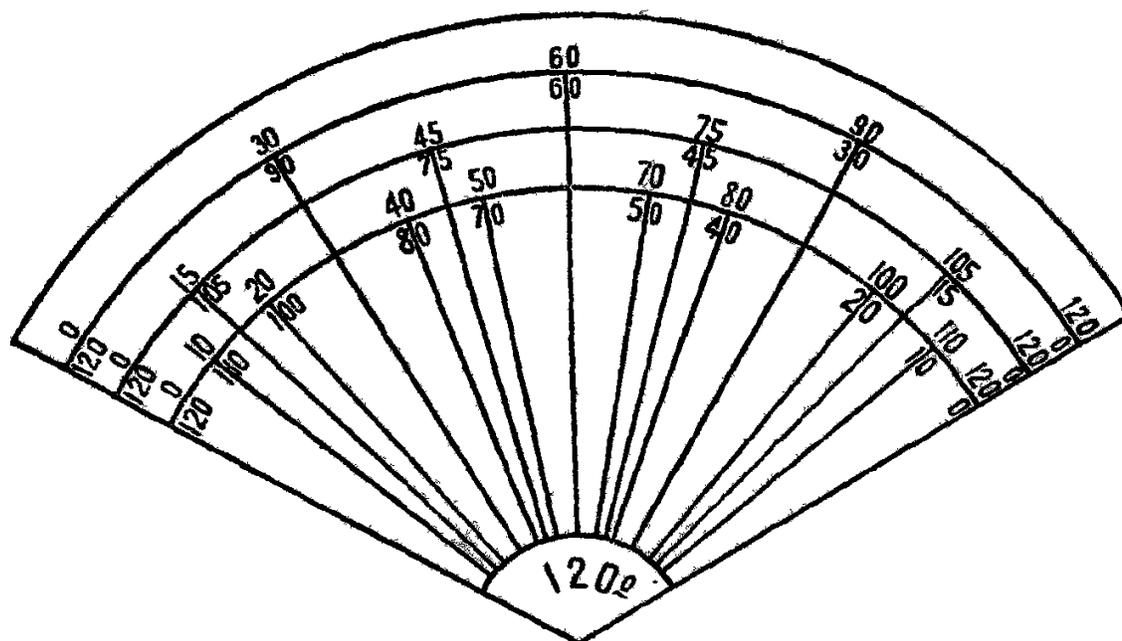
Degree Protractor.
One bears the name Zodiacal, another Hourly, the third Decanic.
Consequently, the instrument allows one to read:
Each pair of primitive colors at 120°.
The generation of their first mixture in equal parts or 60/60.
This, 60/60, being part of the zodiacal system, has not been the object of a separate zone.
From one primitive color to another situated at 120°, the Zodiacal zone shows three mixtures in the proportion of 90/30, 60/60, 30/90: that is, with interferences, 48 colors.
The radii indicating these colors on the Zodiacal Zone of the Protractor bisect the angles of the polygon they cover.
Likewise for the Hourly Zone following the numbers 15/105, 30/90, 45/75, 60/60, 75/45, 90/30, 105/15, that is, with interferences, 168 colors.
Same observations for the Decanic Zone and its Numbers, the Archeometer then being equipped with 12 triangles and a chromological circle of 36 colors yielding, with interferences, a total of 360 colors.
The classification of colors is thus summarized in the practice of our two instruments:
Arithmetical nomenclature of colors by the double Degree Protractor From Blue to Yellow, Series of Greens.
Zodiacal zone: Blue 90 60 30Yellow 30′ 60′ 90′
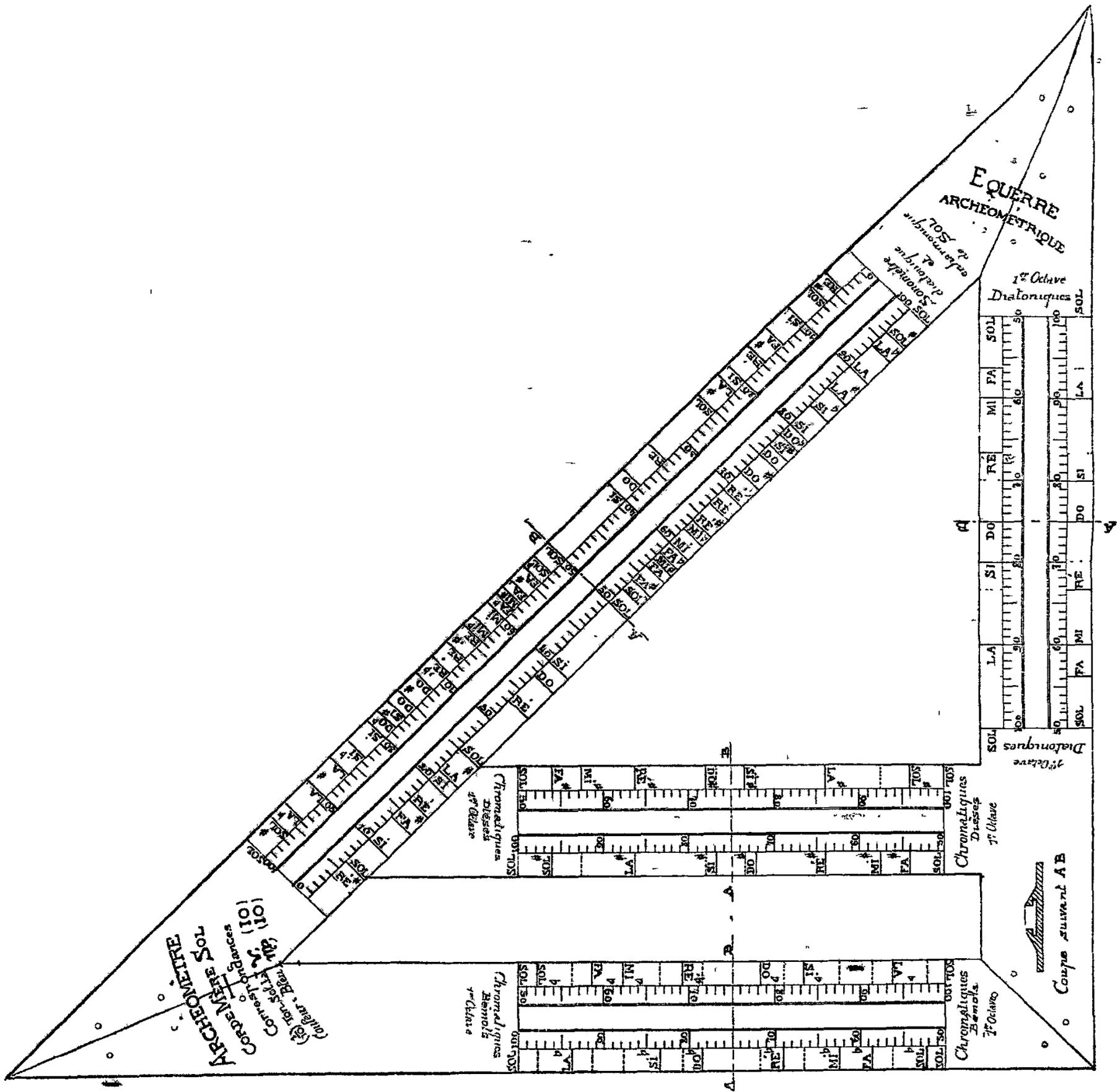
THE ARCHEOMETRIC SQUARE.
Hourly Zone: BlueYellow, 105/15, 90/30, 75/45, 60/60, 45/75, 30/90, 15/105.
Decanic Zone: BlueYellow, 110/10, 100/20, 90/30, 80/40, 70/50, 60/60, 50/70, 40/80, 30/90, 20/100, 10/110.
From Yellow to Red, Series of Oranges—same zones, same numbers as above.
From Red to Blue, Series of Violets—same zones, same numbers as above.
The artist need only determine his Blue, Yellow, and Red according to the covering power he desires. He shall then command them, along with their mixtures, according to the numbers above. Finally, he shall employ them according to these numbers of the protractor and in conformity with the correspondences of the Archeometer.
Let us now return to the chromological correspondences concerning our chapels.
The two extreme lines of the Protractor placed upon the zodiacally equipped Archeometer will bisect the zodiacal blue angle and the zodiacal yellow angle.
The color of the letter M shall be read as zodiacal green: 60 blue60 yellow.
The same operation, applied to the combinations of red and blue, will reveal the letter E as zodiacal violet: 60 red60 blue.
The colors of the name Mary, belonging to the southern triangle, thus represent the first three diatonic combinations of the three primitive rays from the northern trigone—that of the Word-Jesus.
They therefore belong to the diatonic system or the six tones of the scale marked by the number 240 on this same trigone.
But this scale, also comprising 4 chromatics or 12 intervals, allows for the accompaniment of the Melody: of the Name, either according to diatonic harmony or in conformity with zodiacal or chromatic harmony.
To the colors forming the melody of Mary’s name must be added that which corresponds to her Assumption, as Virgin-Mother, Queen of Heaven, of Angels, of patriarchs, and of Saints.
One may read on the Archeometer that this color is blue—the chronological equivalent of wisdom, of the first letter of the Name of the Father and the Son, of the celestial fundamental chord, of the sign of the Virgin, etc.
This is the I of the name Mary as assumed by the Word Jesus.
MUSIC OF SOUNDS
- 1. The Genesis and Synthesis of music. — 2. The music of Time.
- 3. The seven sonometric rules. — 4. The seven Modes.
- 5. The triple enharmonic mode of the Word’s solstices.
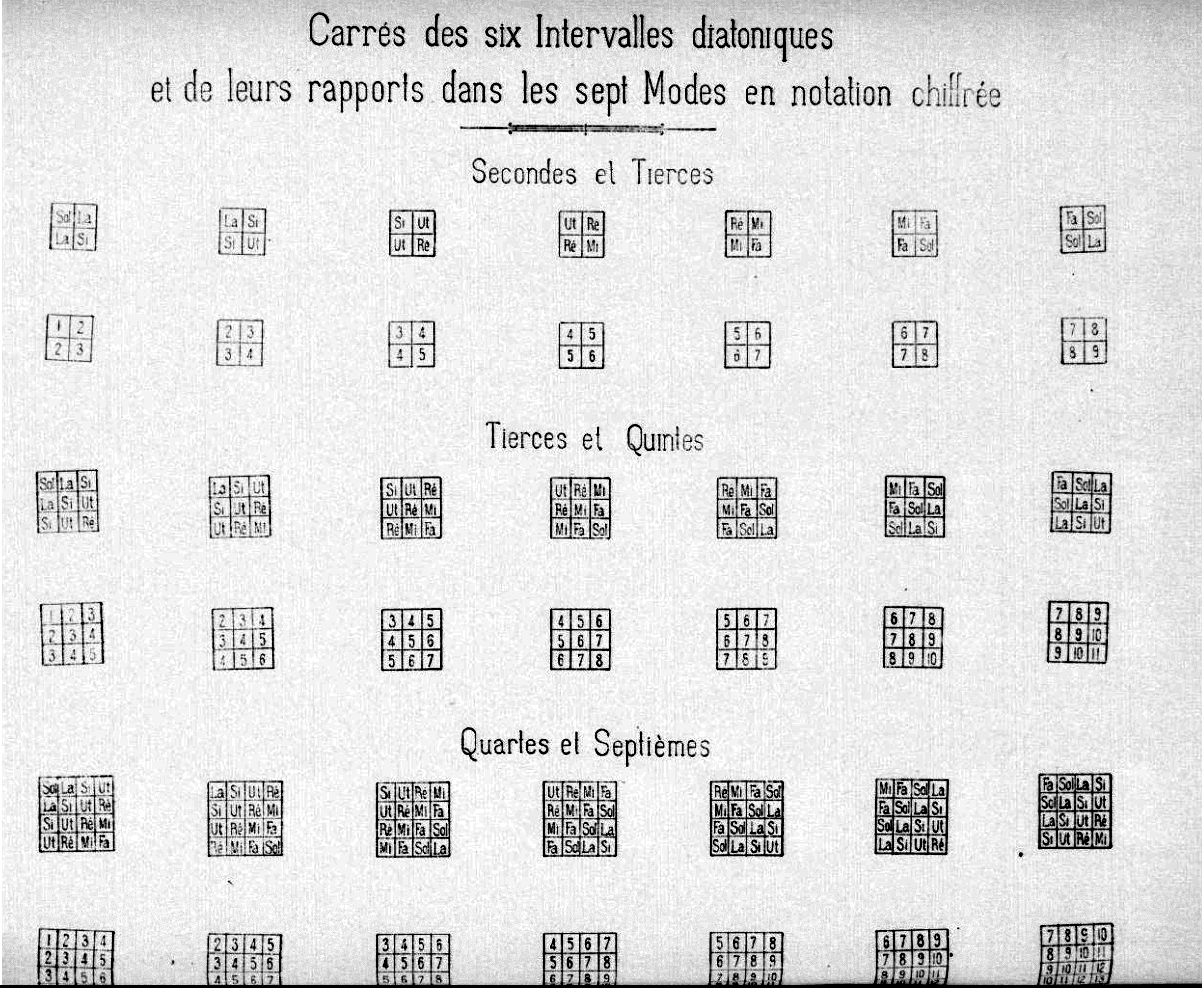
- 6. The squares of the seven intervals, their numerical notation.
- 7. New cosmological Notation, Staff of seven lines.
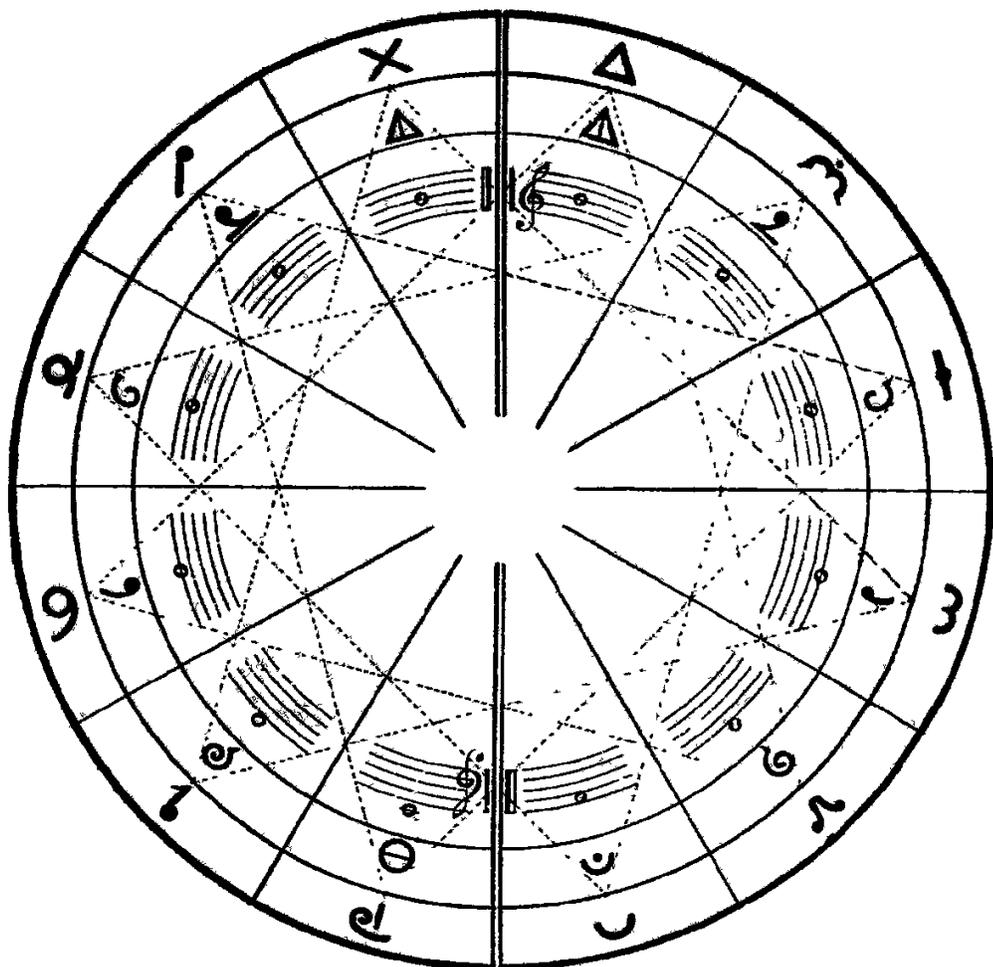
Music and the Archeometer.
All that we have just said concerning the Music of Forms and Colors applies through the same numbers to the music of Sounds and its correspondences with the other languages of the Utterance.
Thus every sacred or liturgical language is transformed upon the Archeometer into melodies bearing the direct imprint of each language’s genius.
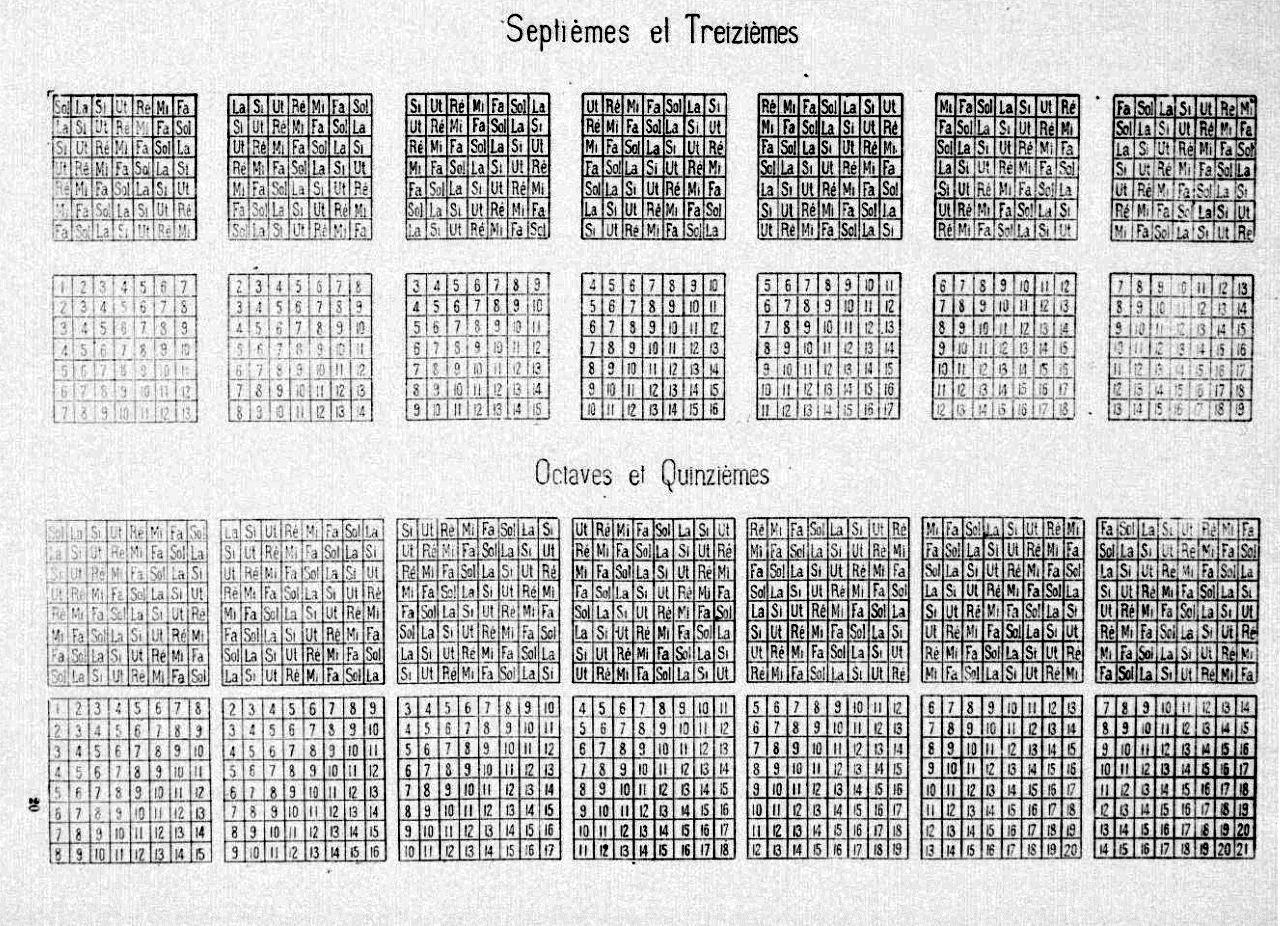
The harmonic accompaniment, according to the numbers governing the Melody, may follow either the Western system or the Eastern systems. Archeometry and its Standard identify them all by reducing them
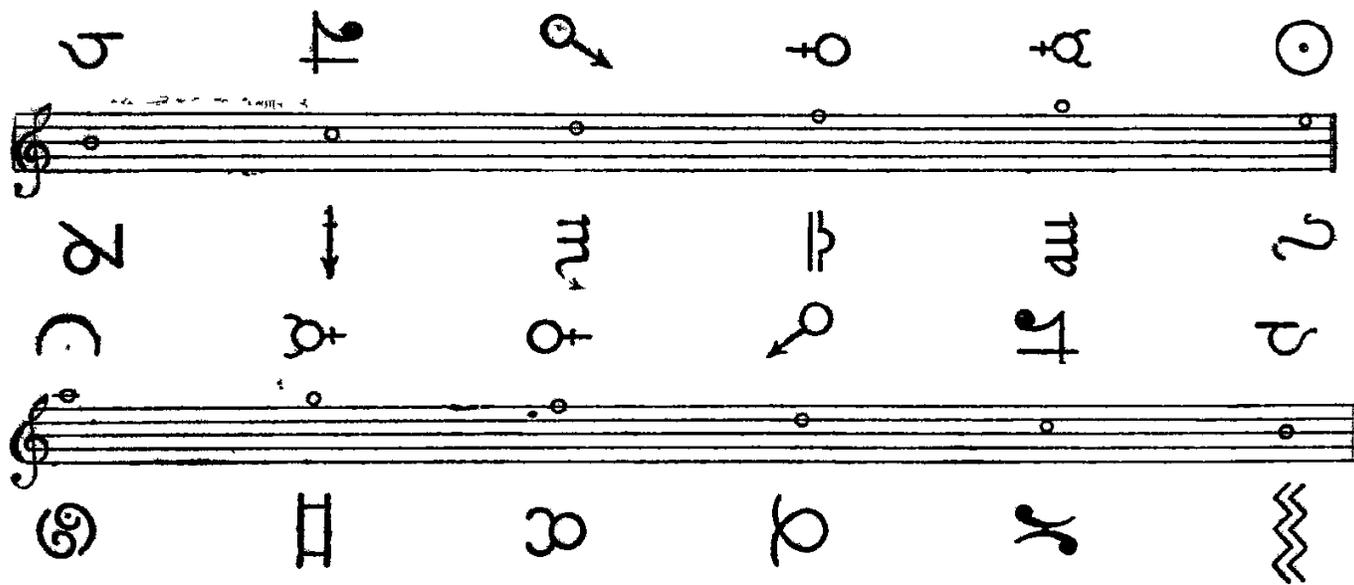
Musical Notes, Planetary and zodiacal Relations.
Squares of the six Diatonic Intervals
and their relations in the seven Modes through numerical notation
The Archeometer.
Musical clef and staff
eliminating the need for flat, natural and sharp signs
while offering other practical advantages
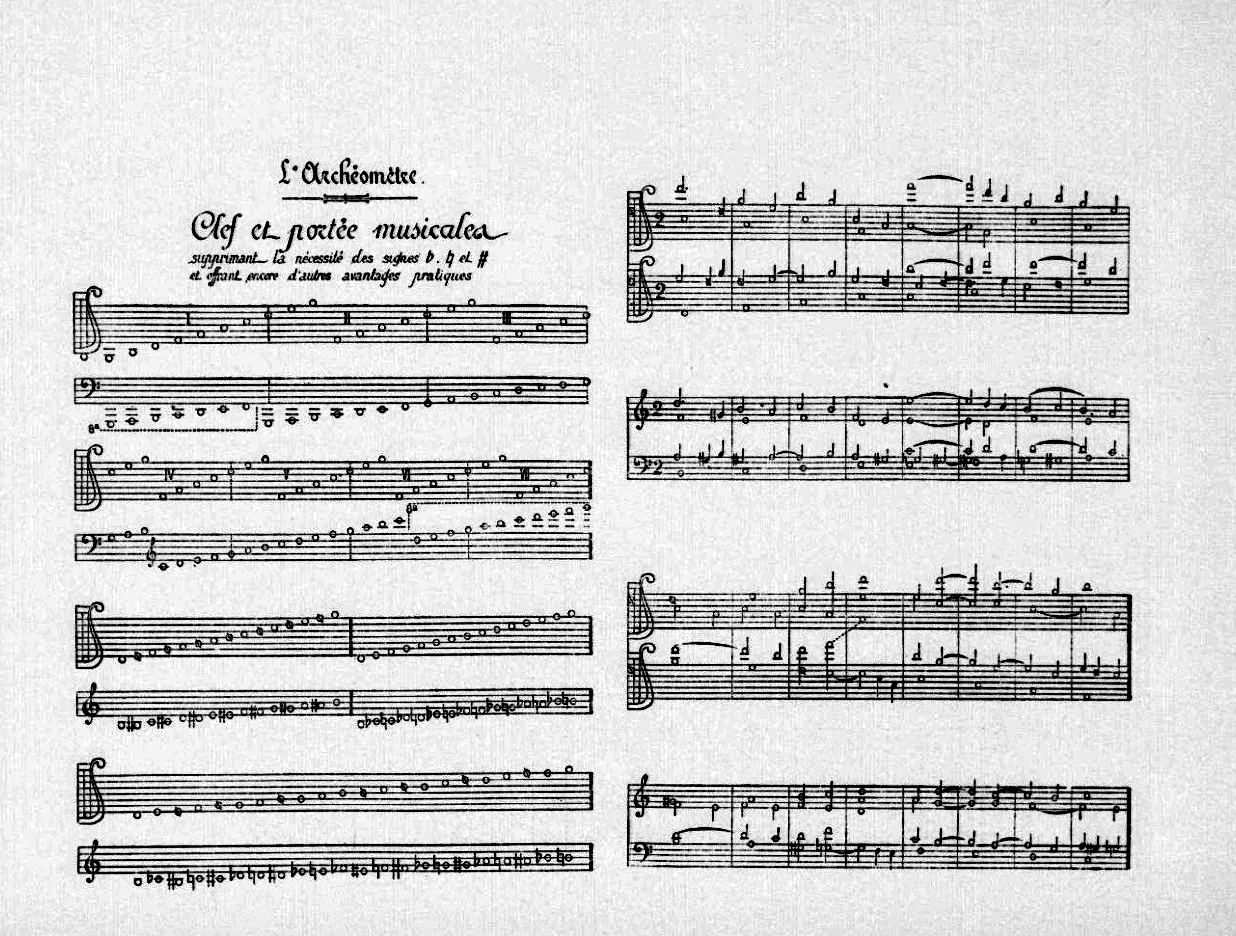
to their exact point of origin within the universal and integral system whose Arithmology and Sonometry they provide.
Nevertheless, it is useful to indicate here some data, then the Archeometric proportional tables, and finally those most commonly used among European peoples. We may employ them all for the same purposes, though we prefer those which are exact from both religious and scientific viewpoints.
SUMMARY
We hope to have clearly demonstrated that the three preceding instruments—the Archeometer, the Standard, and the graduated Protractor—are new organs enabling all the applications we have set forth.
Each of these instruments may be employed in its entirety or according to the elements it contains.
For instance, the Archeometer may be decomposed according to its various frameworks of zones and polygons; these frameworks may be multiplied into hourly or decanic systems, simple, double, triple, etc.
The same instrument may be segmented into sections, reduced to correspondence tables, and these same tables divided into fragments, whether according to Letters, Numbers, or in conformity with their combinations.
The Standard in turn may be segmented into as many rules as there are musical strings, and these may combine into T-squares, angles, squares, parallelograms, triangular pediments, etc.
Finally, the graduated Archeometric sector may itself be segmented or expanded according to the needs of study and application.
As for the Archeometric colors, we may reduce them into scales, into harmonic series and, through rotation, obtain musical zones of new colors unknown in current systems and quantifiable according to the vast numbers of combinations possible with the XXII intervals.
We also reserve the application of our Standard to Sonometry instruments.
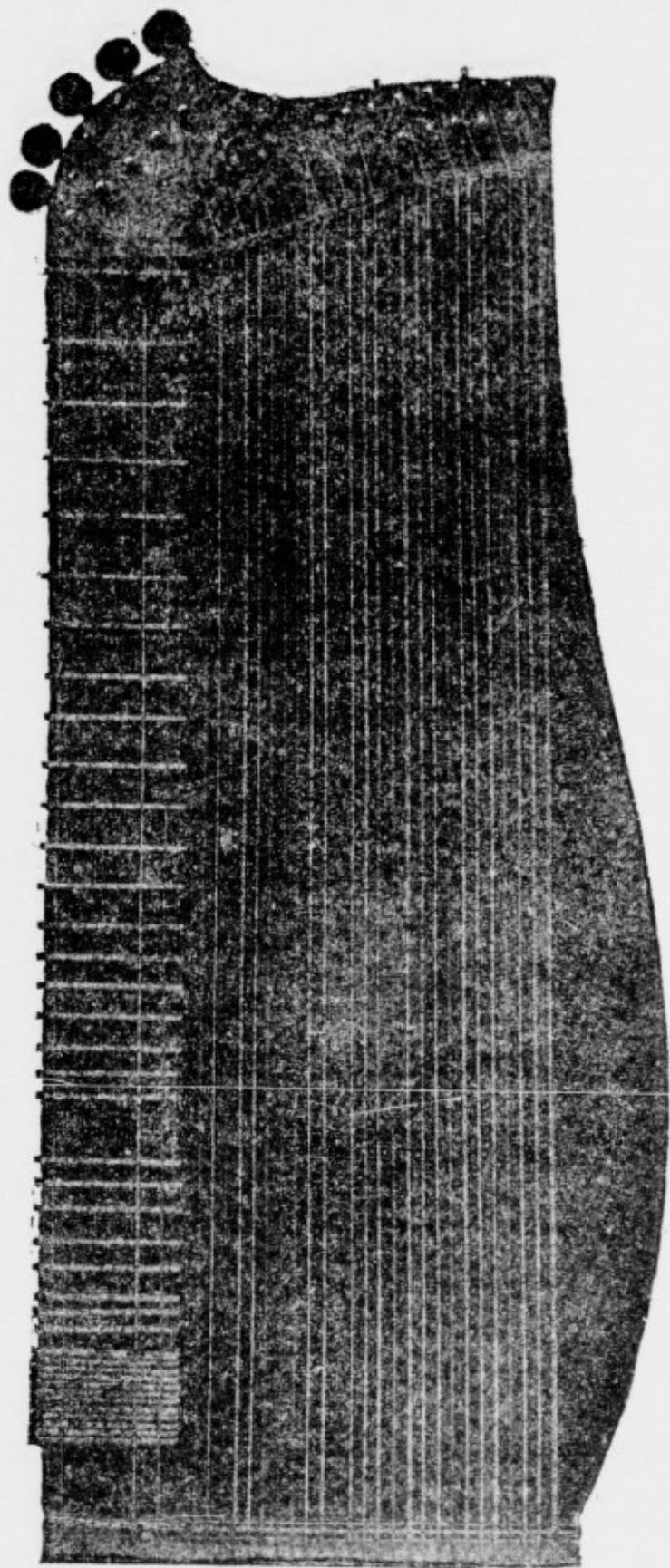
The same applies to a system of movable or fixed bars at will, adaptable to stringed instruments such as zithers.
In this adaptation, the sonometric study will correlate the bars or intervals with the numbers whose series one wishes to study, whether simply or comparatively.
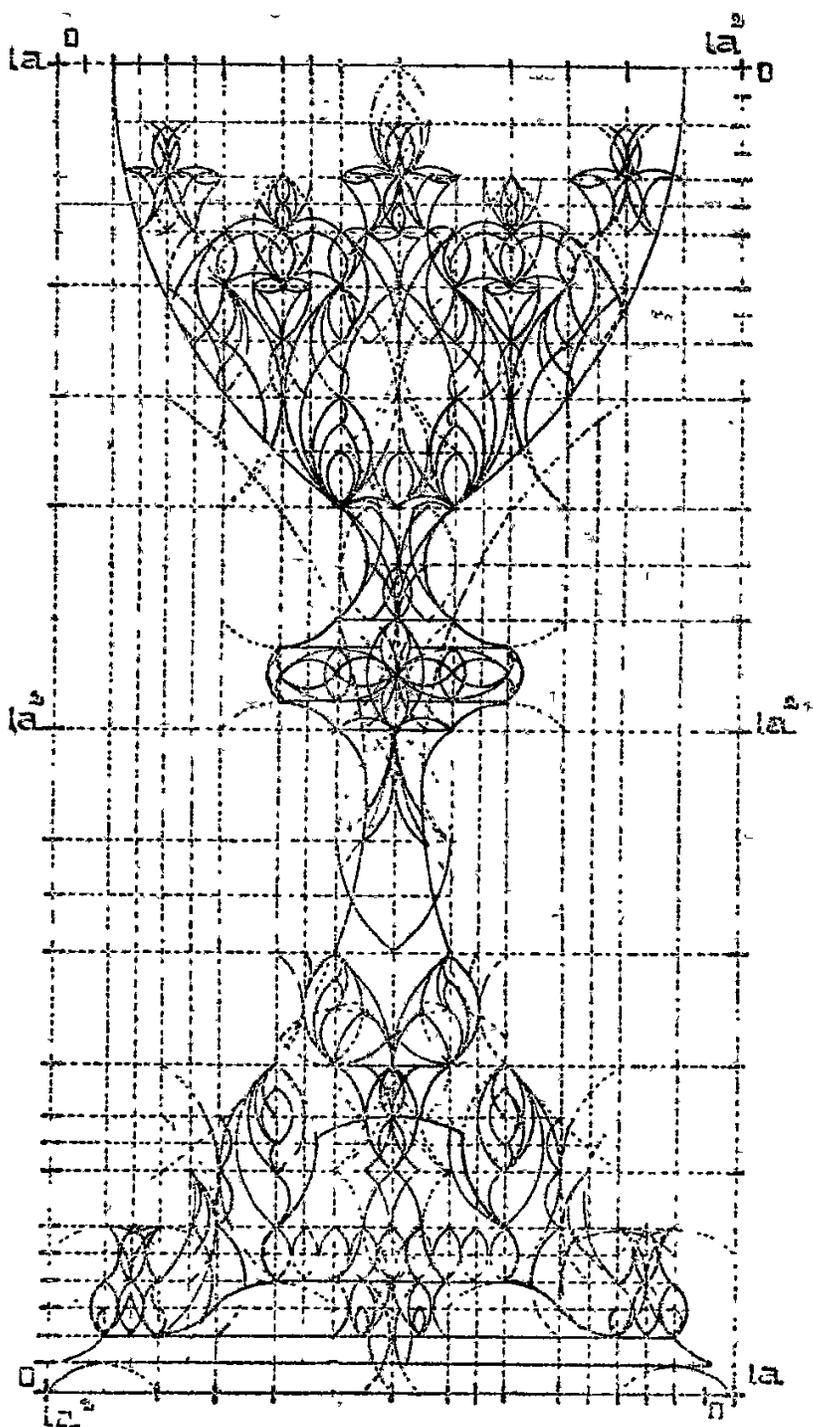
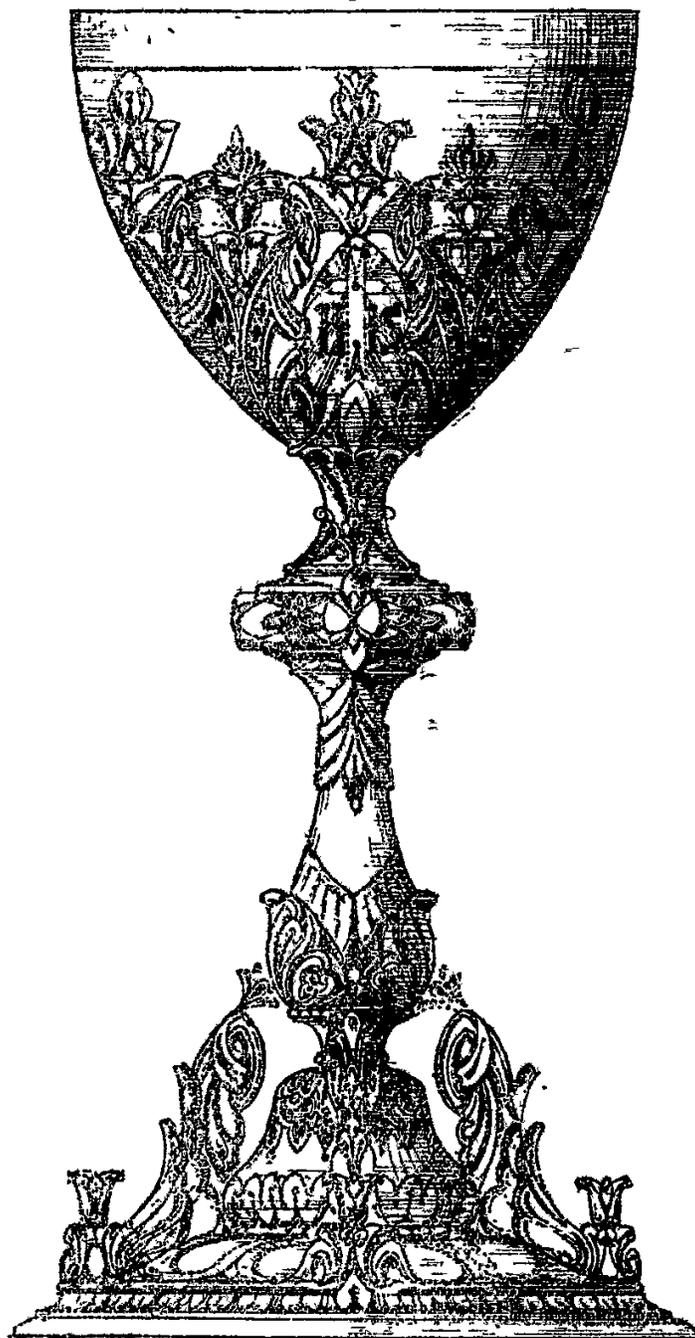
A CHALICE (Chord La, Ut, Mi ).
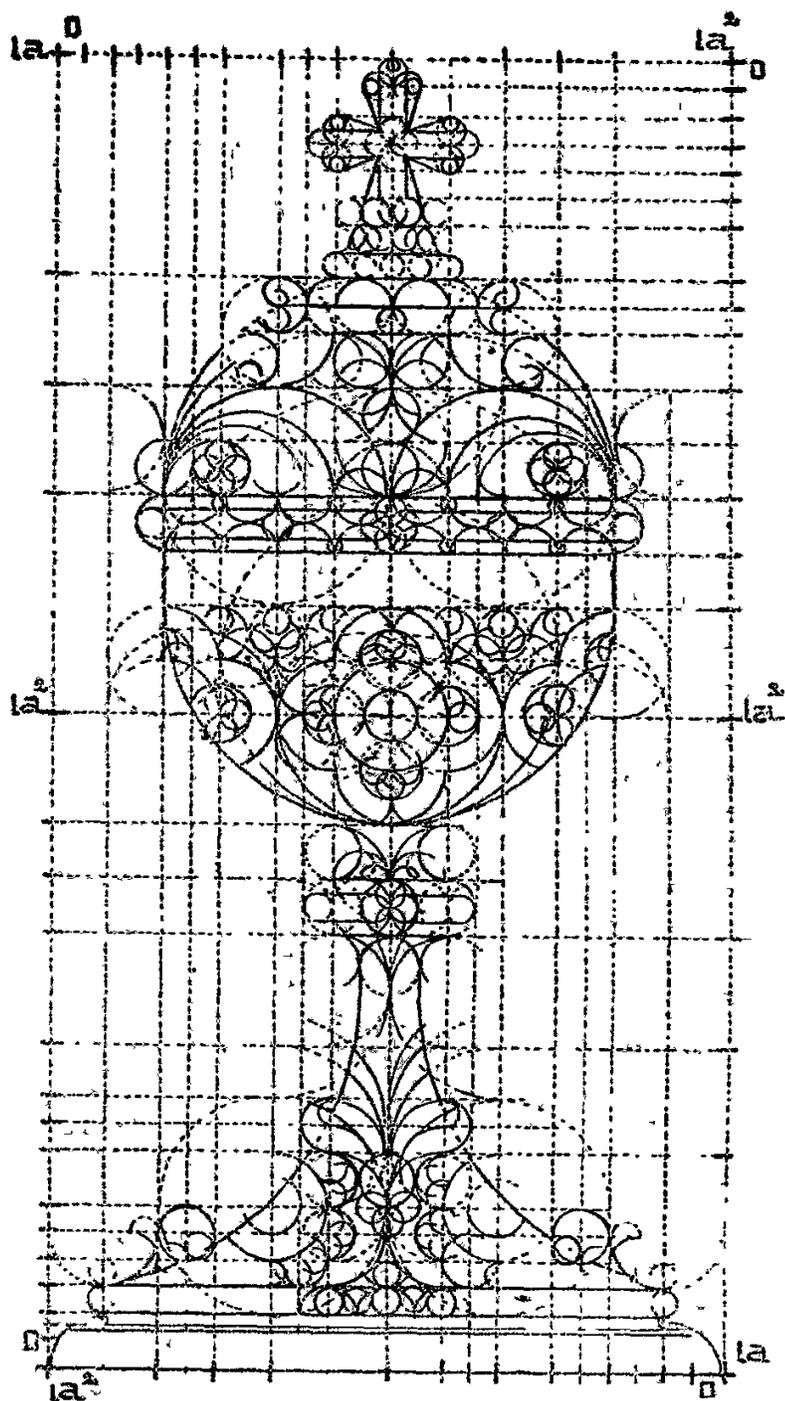
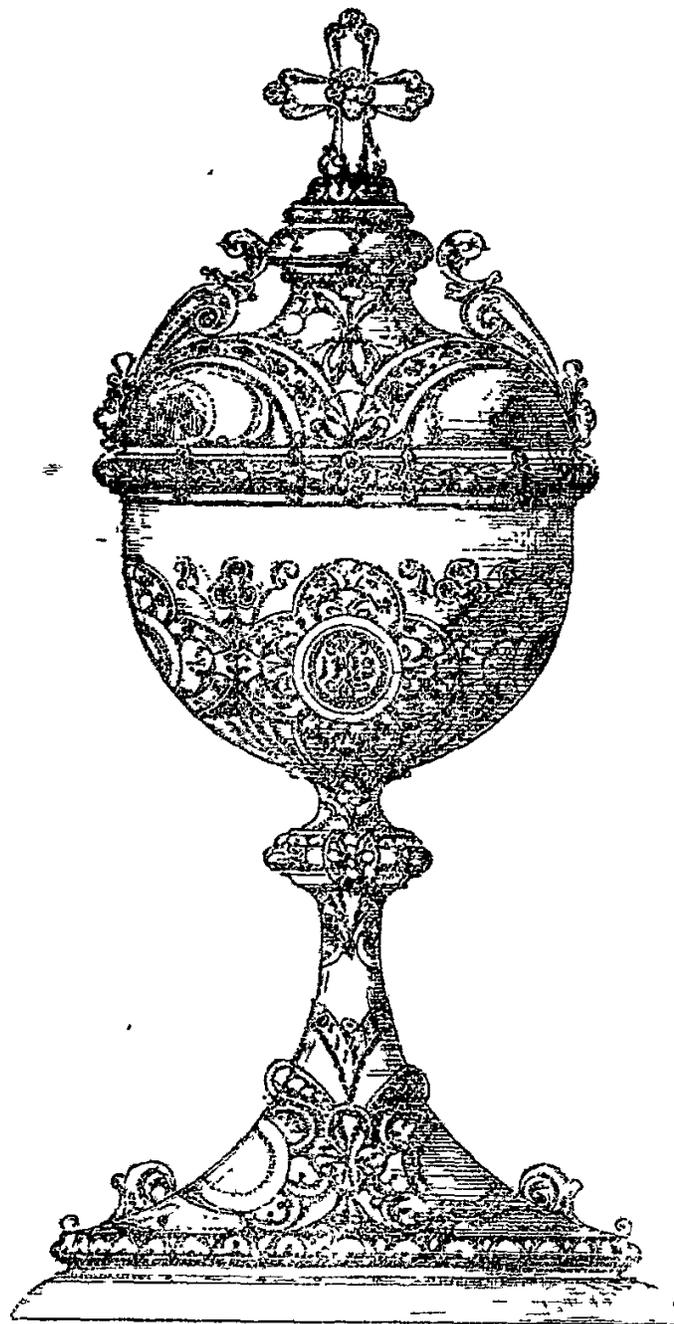
A CHALICE.
A detailed example is worth more than many theoretical developments to show the application of the Principles given by the Archeometer.
This is why we shall provide a series of plates graciously communicated by Mr. Gougy, showing in detail the architectural adaptation of the chord La, Ut, Mi.
The Grande Chapelle[*], Gothic style corresponding to this chord, is presented in the following eight plates from all aspects, and we are convinced that the study of these figures will interest all architects and art lovers.
It will be recalled that, thanks to the Archeometer, all objects contained within the chapel (1), as well as the stained glass and decoration, are precisely adapted to the notes—that is, to the letters and the name materialized by the chapel.
The style of each object and the color change with each divine name.
For colors, the chromatic scales and pavilions will indicate these relationships.
(1) See THE CHALICES above. ↩
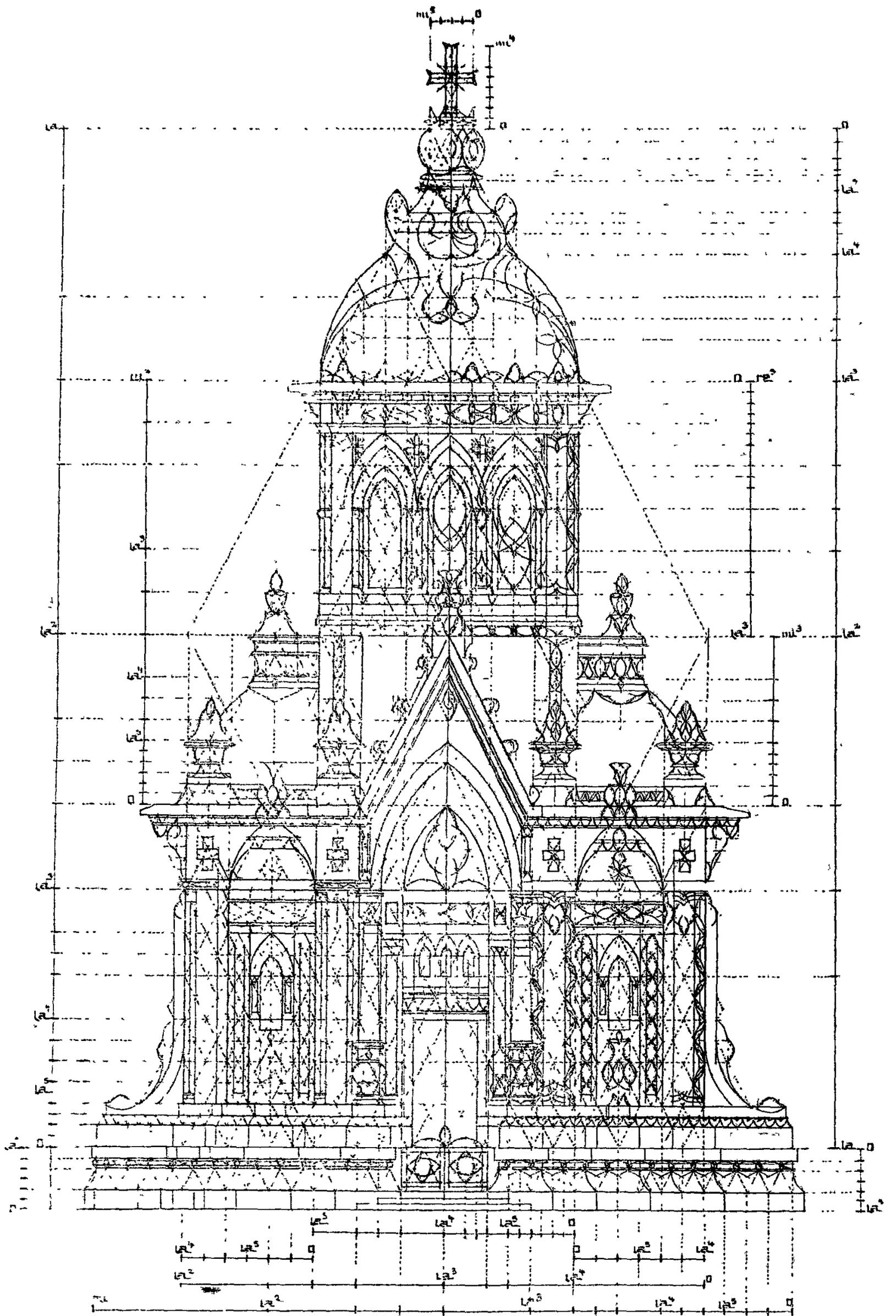
GRANDE CHAPELLE. — Facade (Gothic style). — Chord La, Ut, Mi.
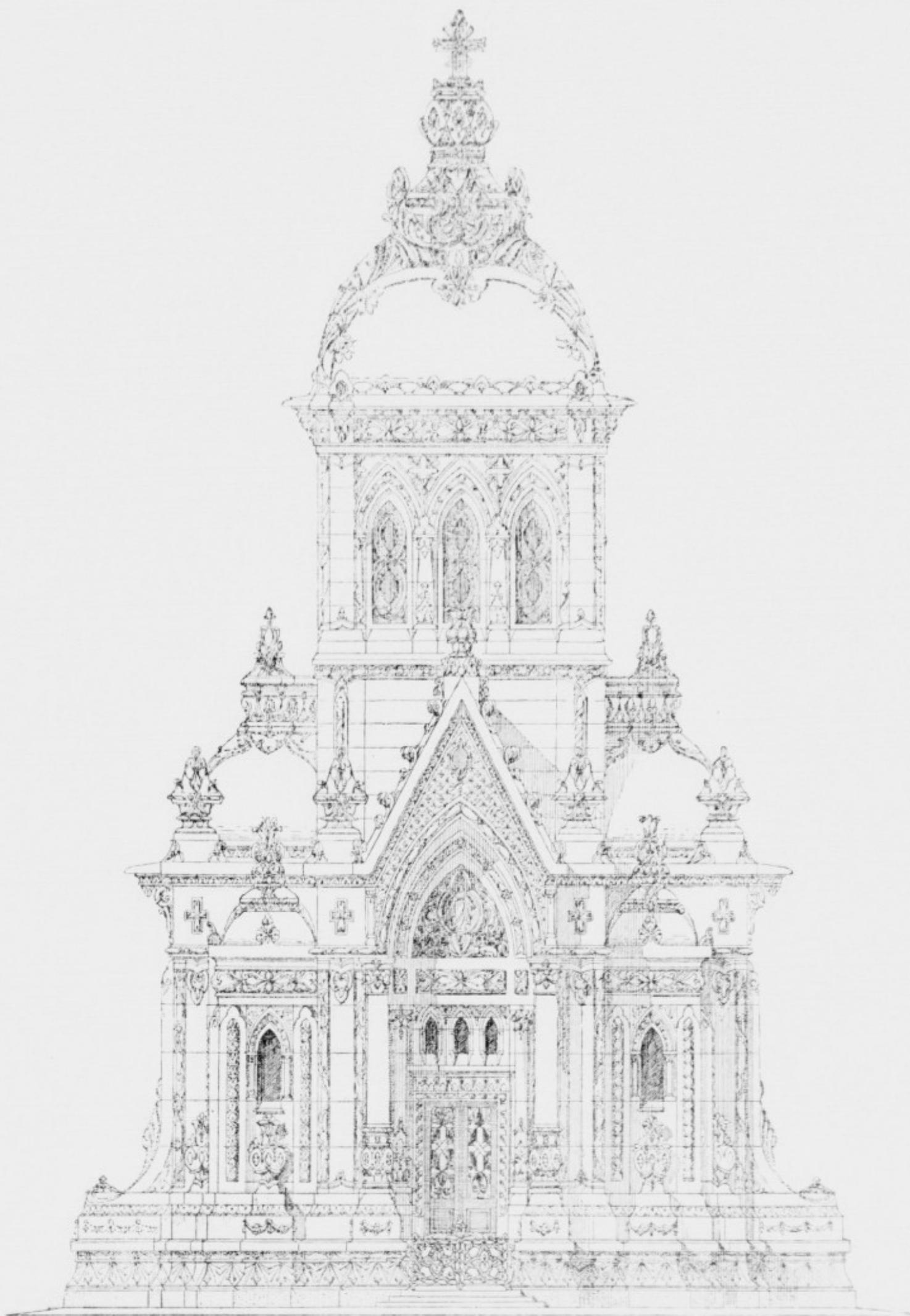
GRANDE CHAPELLE. — Facade (Gothic style). — Chord La, Ut, Mi.
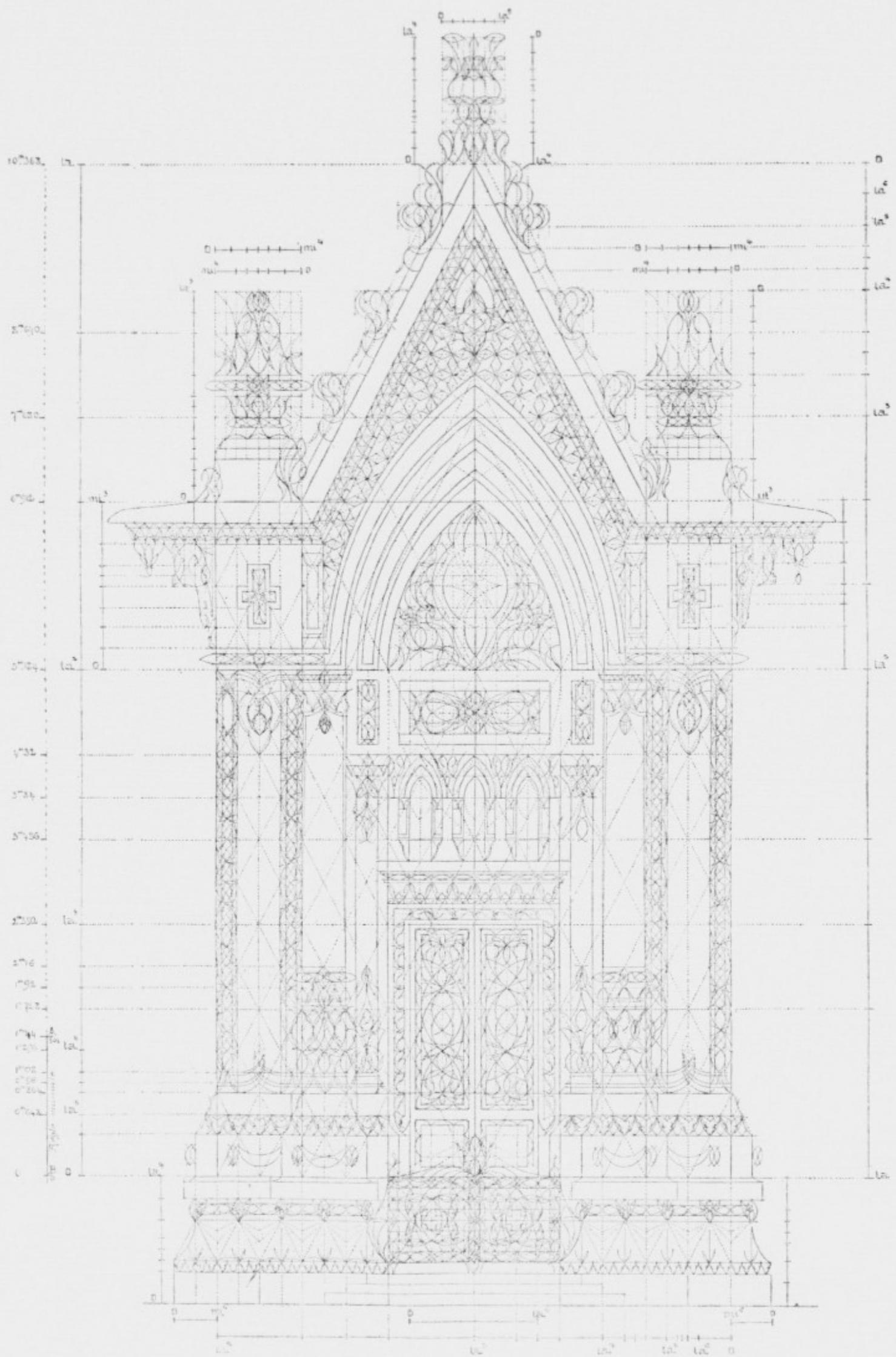
GRANDE CHAPELLE. — Detail of the Porch and Entrance Door (Gothic style). — Chord La, Ut, Mi.
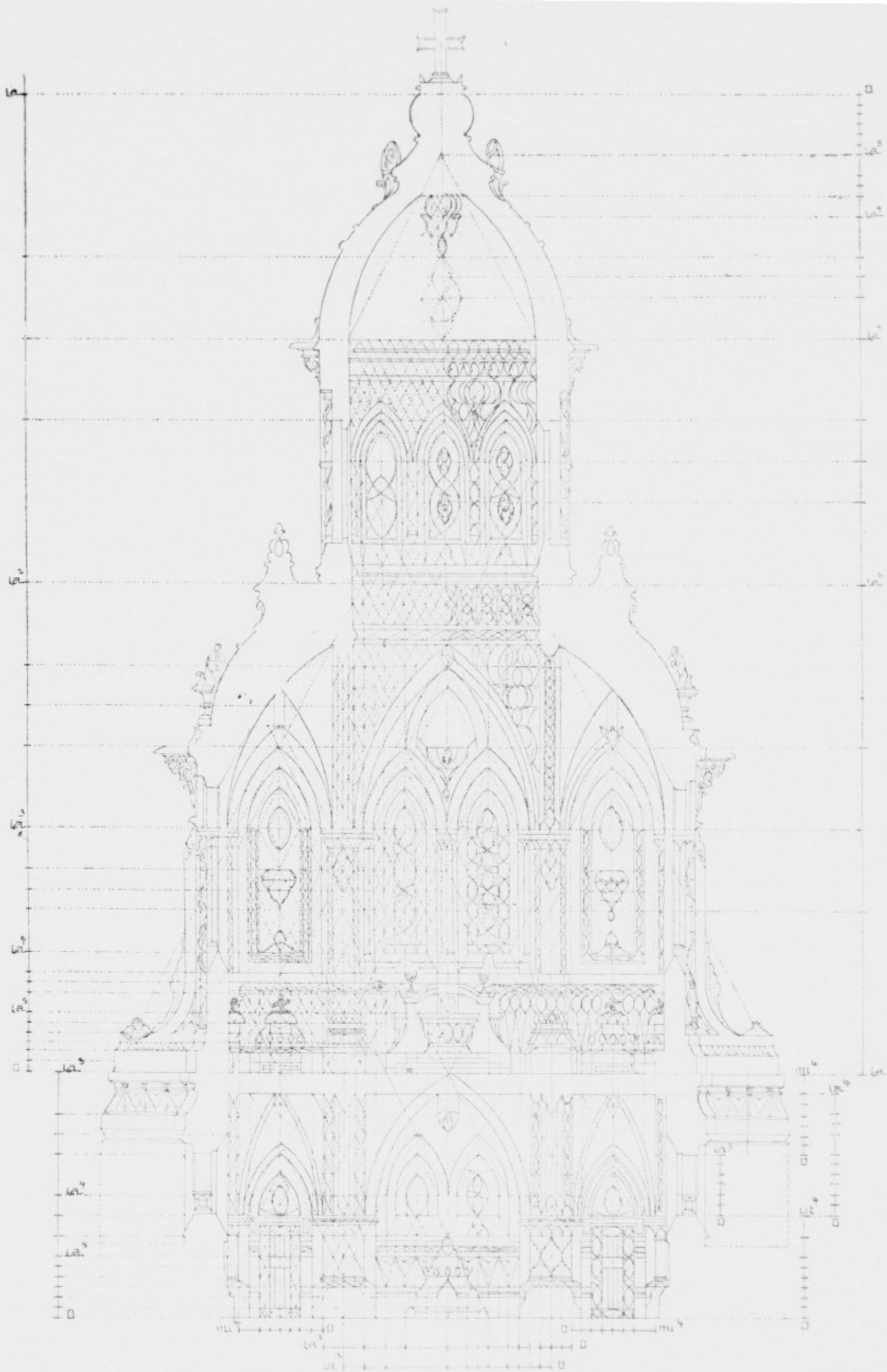
GRANDE CHAPELLE. — Cross-section (Gothic style). — Chord La, Ut, Mi.
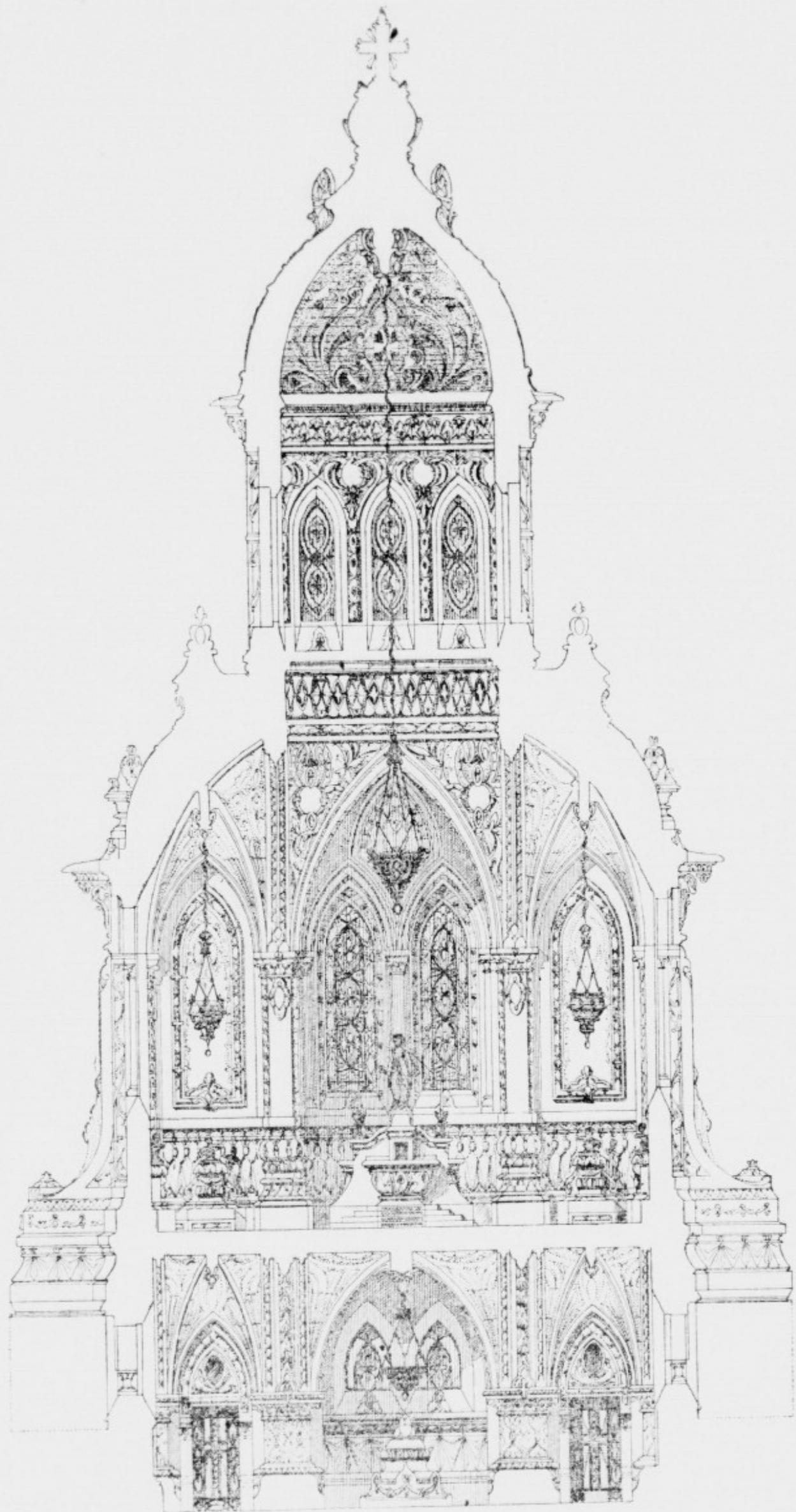
GRANDE CHAPELLE. — Cross-section.
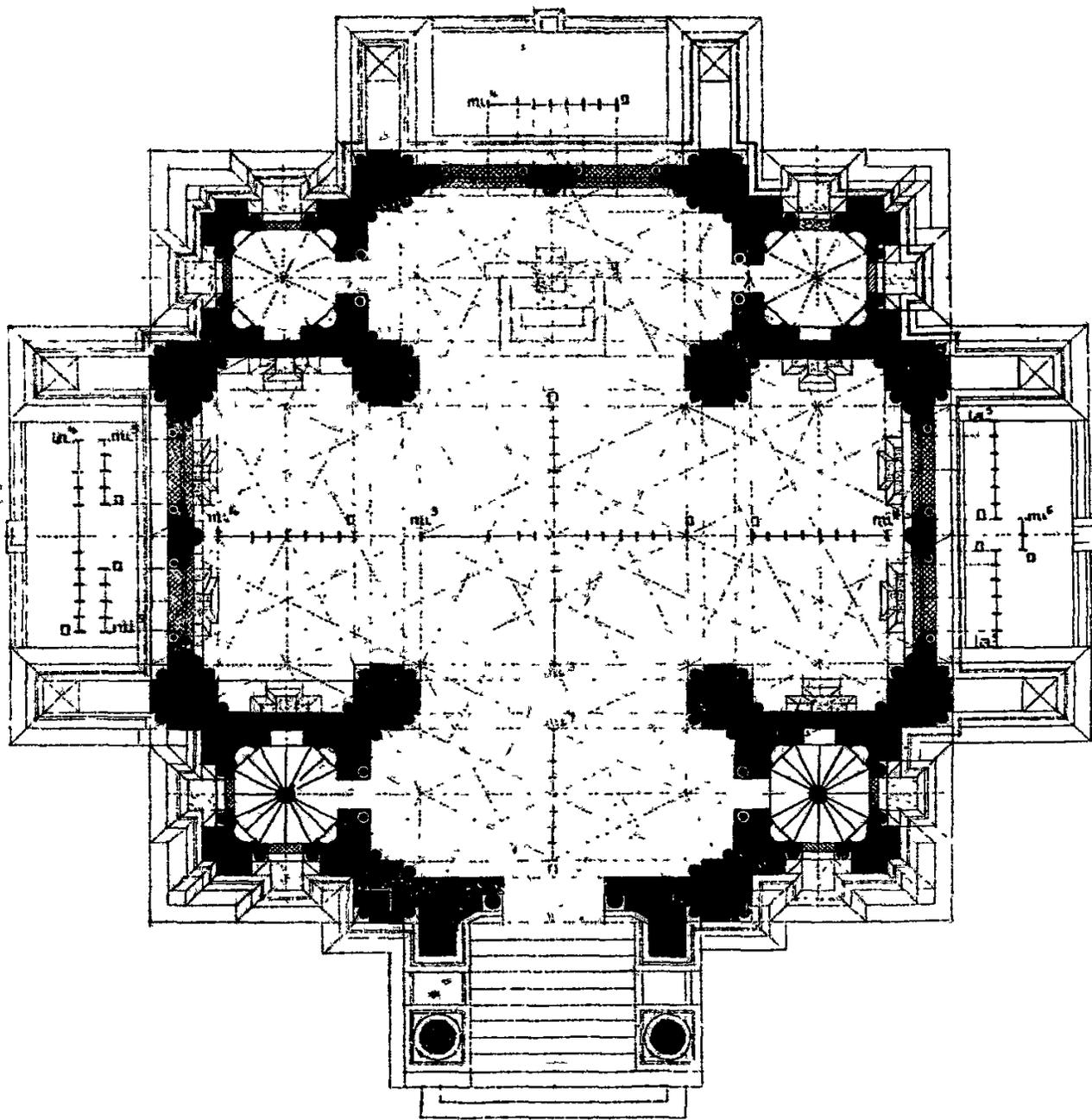
GRANDE CHAPELLE. — Floor plan (Gothic style).
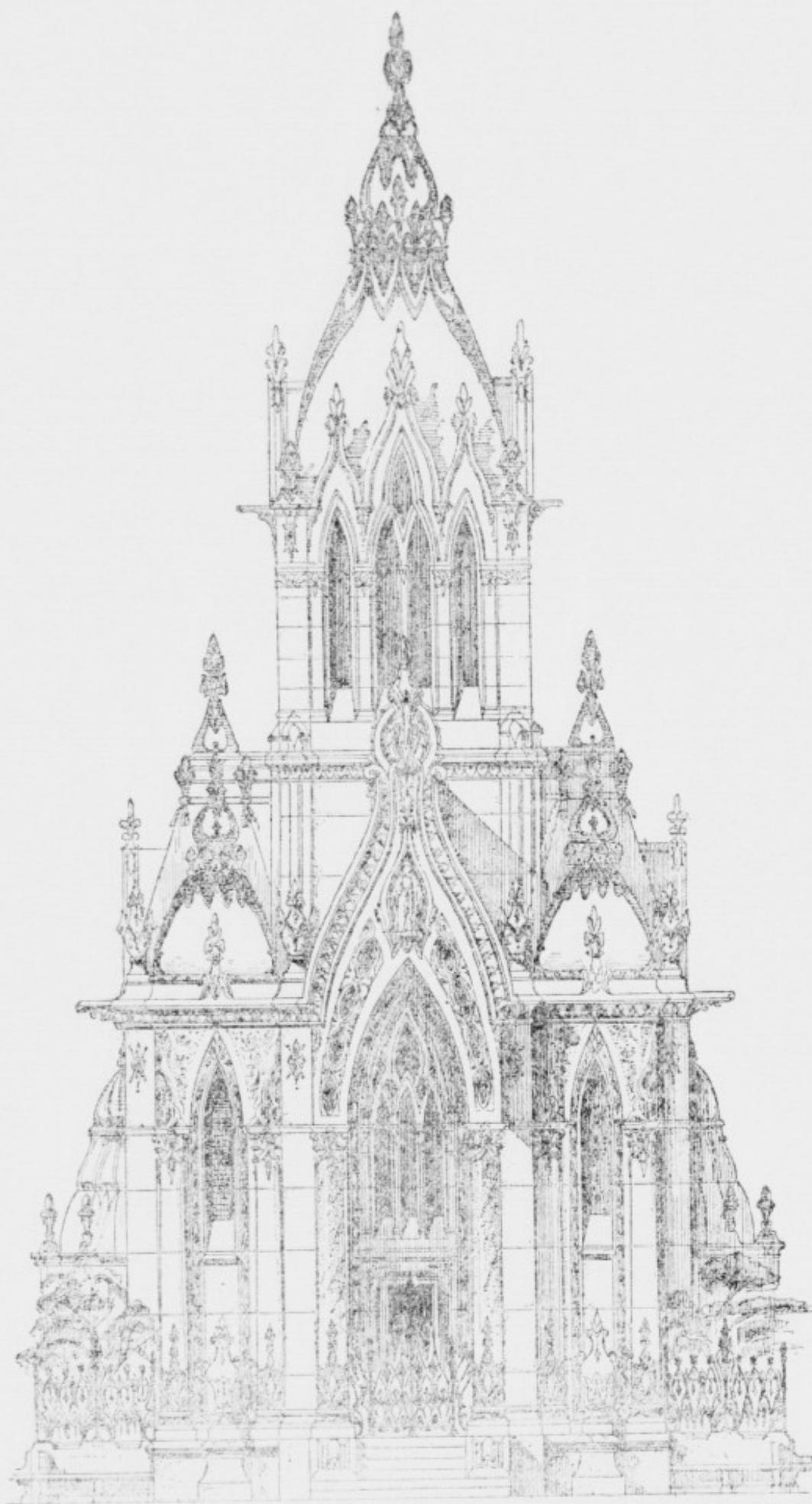
GRANDE CHAPELLE (Gothic style). — Chord La, Ut, Mi.
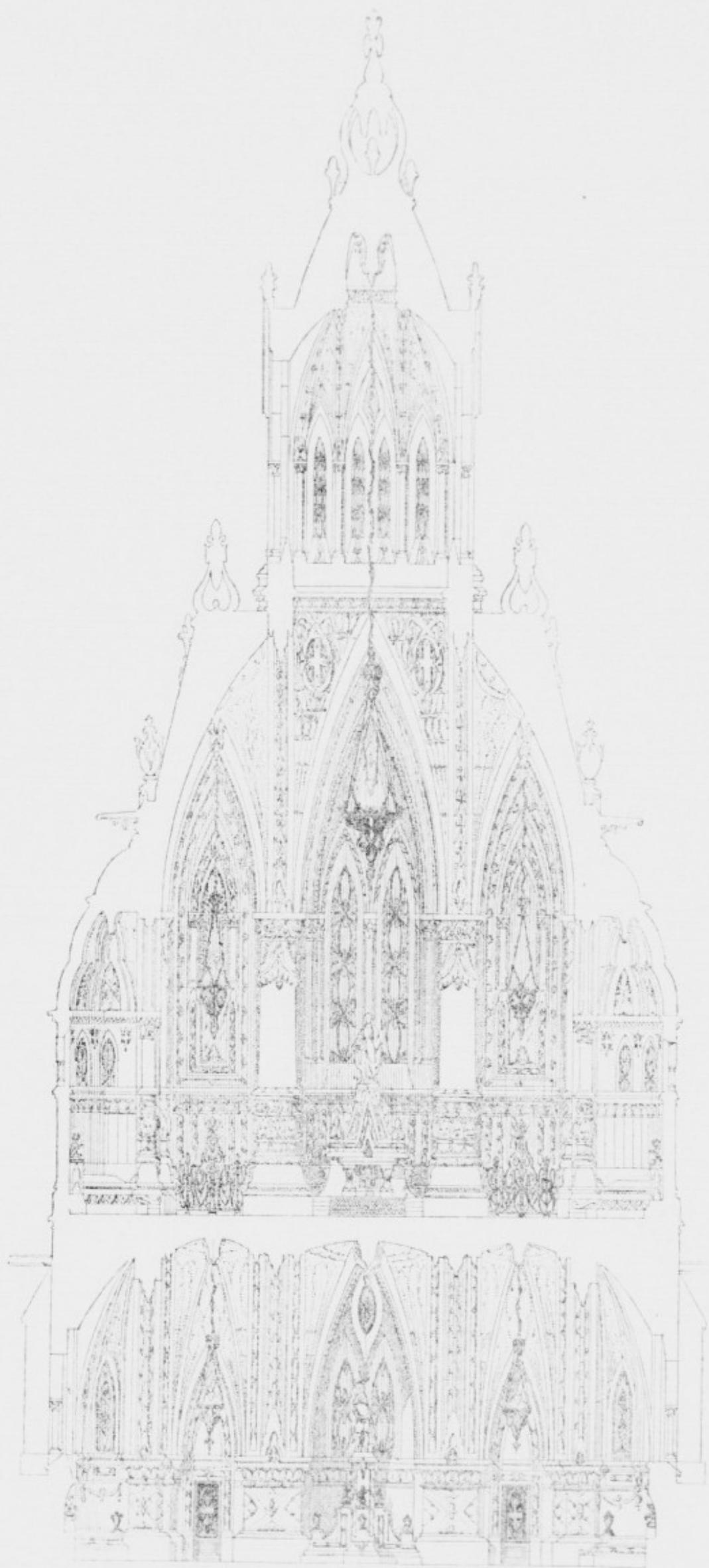
GRANDE CHAPELLE — Facade and Cross-section as demonstration figure (Gothic style). — Chord La, Ut, Mi.
T-46 — Translator’s Note: Regarding the patent — particularly the standard and the adaptations — reproduced in full below. ↩
T-48 — Translator’s Note: See the chalices above. ↩